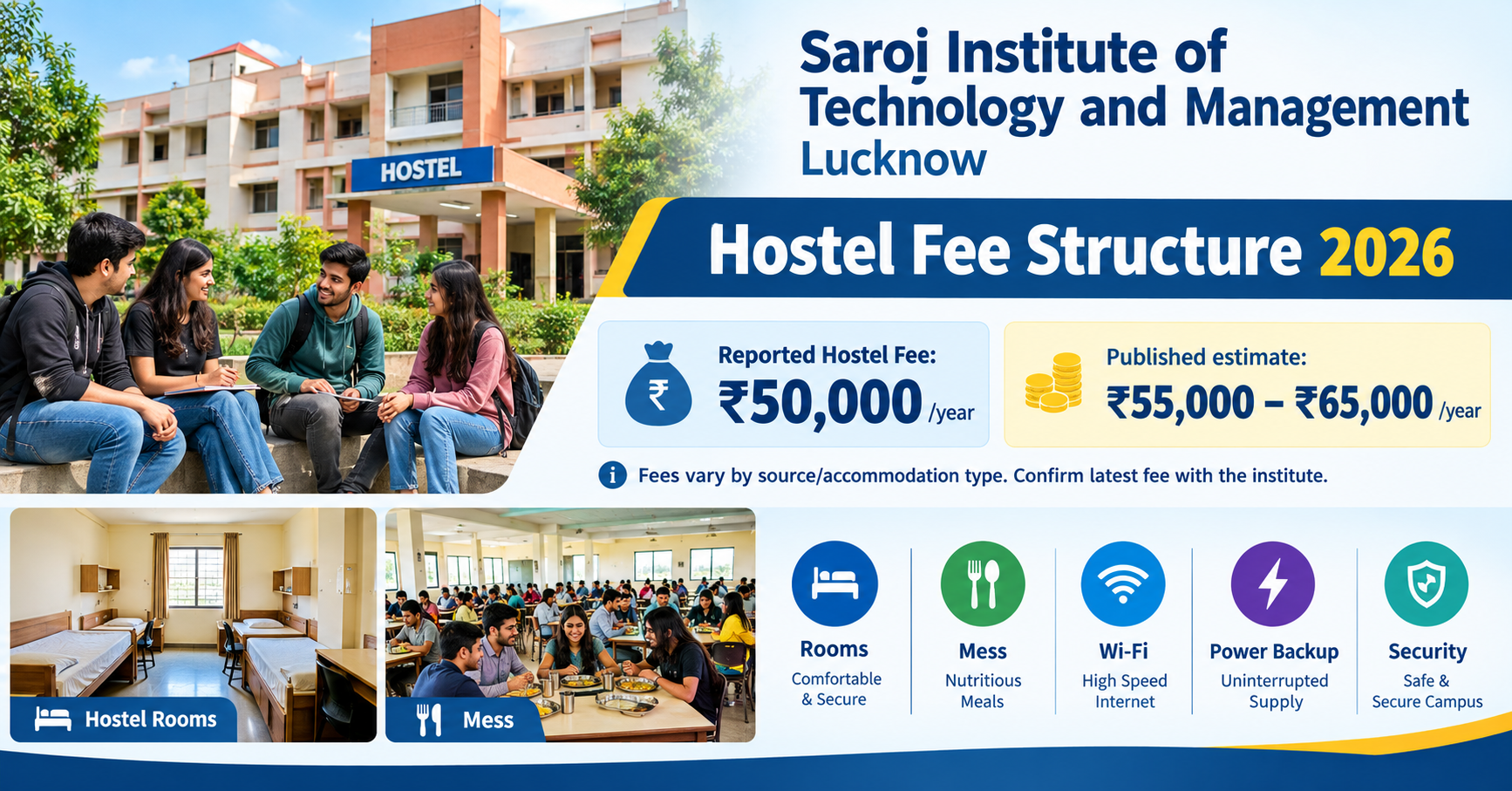
Saroj Institute of Technology and Management Lucknow hostel fee structure
Saroj Institute of Technology and Management (SITM) Lucknow charges approximately ₹2.40–3.80 lakh as total tuition for the four-year B.Tech programme and higher fees (up to ₹4.50 lakh) for B.Pharm. Hostel accommodation costs between ₹50,000 and ₹90,000 per year depending on room sharing and mess inclusion. All figures are indicative and must be confirmed from the latest official fee circular issued by the institute.
⚡ Quick Answer
Saroj Institute of Technology and Management (SITM) Lucknow B.Tech total fees range from ₹2.40 lakh to ₹3.80 lakh for four years. B.Pharm fees are higher (approximately ₹2.82–4.50 lakh). Hostel charges typically range from ₹50,000 to ₹90,000 annually depending on room type and mess. Exact figures should be confirmed from the official circular
📌 Key Takeaways
- B.Tech total tuition fees at SITM Lucknow: ₹2.40 – 3.80 lakh (4 years) Annual B.Tech fee component: approximately ₹60,000 – ₹85,000 B.Pharm total fees: ₹2.82 – 4.50 lakh Diploma programmes: around ₹1.00 – 1.20 lakh for 3 years MBA / M.Tech total fees: roughly ₹1.20 – 1.80 lakh Hostel fees: ₹50,000 – ₹90,000 per year (depending on occupancy and mess) Additional charges include examination, library, technology and miscellaneous fees Fees are subject to revision; always verify with the official SITM circular Scholarships and fee waivers can reduce the net payable amount Hostel allotment is optional and based on availability Last Verified Date:
Saroj Institute of Technology and Management (SITM), situated at Ahimamau, Arjunganj, Sultanpur Road, Lucknow, Uttar Pradesh, is a private technical institution established in 2001 under the Saroj Educational Group. The institute is affiliated with Dr. A.P.J. Abdul Kalam Technical University (AKTU), Lucknow, and holds approvals from the All India Council for Technical Education (AICTE). Pharmacy programmes additionally carry recognition from the Pharmacy Council of India (PCI).
Over more than two decades, SITM has developed a multi-disciplinary academic portfolio covering engineering, pharmacy, management, and diploma-level technical education. The fee structure reflects the standard private-college model prevalent in Uttar Pradesh, combining core tuition with examination, laboratory, library, and optional residential charges. All figures discussed here are indicative, drawn from institutional and educational portal data for recent academic cycles. Prospective students must verify the latest official circular from the admissions office or the institute website (seglko.org), as fees remain subject to revision by the university or fee fixation authorities.
Overall Academic Fee Landscape
The total cost of education at SITM varies significantly by programme duration, branch demand, and regulatory category. Engineering programmes form the largest segment, while pharmacy courses command higher investment due to laboratory intensity. Diploma and postgraduate programmes occupy intermediate ranges.
Indicative Total Tuition Fee Range by Programme Category
| Programme Category | Duration | Approximate Total Tuition Fee (INR) | Typical Annual Range (INR) |
|---|---|---|---|
| B.Tech / B.E. | 4 years | 2.40 – 3.80 lakh | 60,000 – 85,000 |
| B.Pharm | 4 years | 2.82 – 4.50 lakh | 1.00 – 1.05 lakh |
| Diploma / Polytechnic | 3 years | 1.00 – 1.20 lakh | 30,000 – 40,000 |
| MBA | 2 years | 1.20 – 1.80 lakh | 60,000 – 90,000 |
| M.Tech | 2 years | 1.20 – 1.28 lakh | 60,000 |
| M.Pharm | 2 years | 1.53 – 2.80 lakh | 75,000 – 1.10 lakh |
| MCA | 2–3 years | 1.10 – 1.84 lakh | 36,000 – 60,000 |
These totals primarily represent tuition. Examination fees payable to AKTU, laboratory development charges, library fees, and miscellaneous institutional levies are usually additional.
Detailed Engineering (B.Tech) Fee Structure
B.Tech remains the flagship offering at SITM, with multiple specialisations. Fees differ modestly between high-demand computer-related branches and traditional core branches.
Branch-Wise Approximate Fee Pattern for B.Tech
| Specialisation | Approximate Annual Fee (INR) | Estimated 4-Year Total (INR) | Seats (Indicative) |
|---|---|---|---|
| Computer Science & Engineering | 85,000 | 3.40 lakh | 120 |
| Information Technology | 85,000 | 3.40 lakh | 60–120 |
| Artificial Intelligence / Data Science / Cyber Security | 85,000 | 3.40 lakh | Variable |
| Mechanical Engineering | 75,000 | 3.00 lakh | 90–120 |
| Civil Engineering | 75,000 | 3.00 lakh | 60 |
| Electrical / Electronics & Communication | 75,000 | 3.00 lakh | 30–120 |
| Biotechnology / Biomedical | 75,000–85,000 | 3.00–3.40 lakh | 60–120 |
Pharmacy Programme Fees
Pharmacy courses involve higher infrastructure and regulatory compliance costs, which is reflected in the fee structure.
Pharmacy Fee Overview
| Programme | Duration | Approximate Annual Fee (INR) | Estimated Total Fee (INR) |
|---|---|---|---|
| B.Pharm | 4 years | 1.00 – 1.05 lakh | 2.82 – 4.50 lakh |
| D.Pharm | 2 years | 50,000 – 85,000 | 1.00 – 1.70 lakh |
| M.Pharm | 2 years | 75,000 – 1.10 lakh | 1.53 – 2.80 lakh |
B.Pharm remains the most significant investment among undergraduate pharmacy offerings.
Diploma, Management and Postgraduate Fees
Diploma programmes provide an economical entry route into technical education. Management and postgraduate engineering courses follow a more compact two-year structure.
Selected Non-Engineering Programme Fees
| Programme | Duration | Approximate Total Fee (INR) | Notes |
|---|---|---|---|
| Diploma (various) | 3 years | 1.00 – 1.20 lakh | Annual component ≈ ₹30,000–40,000 |
| MBA | 2 years | 1.20 – 1.80 lakh | Specialisations in Finance, HR, IT, Operations |
| M.Tech | 2 years | 1.20 – 1.28 lakh | Core and computer-related streams |
| MCA | 2–3 years | 1.10 – 1.84 lakh | — |
Additional Academic and Administrative Charges
Beyond tuition, several ancillary charges apply. These are often collected annually or at the time of admission.
Common Additional Cost Components
| Cost Type | Approximate Amount (INR) | Frequency |
|---|---|---|
| Application / Registration | 1,000 | One-time |
| Examination Fees (AKTU) | 5,000 (indicative) | Annual / Semester |
| Library / Technology Fee | 3,500 | Annual |
| Miscellaneous / Development | 2,000 | Annual |
| Uniform Fee | Variable | One-time |
| Caution / Security Deposit | Variable | Refundable |
These figures are estimates drawn from secondary compilations and may vary. The exact break-up appears in the official demand note issued by the institute.
Hostel and Residential Fee Structure
SITM maintains separate hostels for boys and girls. Residential charges constitute a major optional expense for outstation students.
Hostel Fee Options (Indicative Annual Charges)
| Room Type | Lodging Fee (INR) | Mess Fee (INR) | Approximate Total Annual Cost (INR) |
|---|---|---|---|
| Triple Sharing | 30,000 | 30,000 | 60,000 |
| Double Sharing | 40,000 | 30,000 | 70,000 |
| Single Occupancy | 60,000 | 30,000 | 90,000 |
| Standard Package | — | — | ≈ 50,000 (combined in some listings) |
Factors That Influence the Final Payable Amount
Several variables determine the net cost a student ultimately pays:
- Programme and Branch Selection: Computer science and pharmacy streams generally sit at the higher end of the fee spectrum.
- Admission Category: Counselling seats (UPTAC / JEE Main / JEECUP) often follow regulated ceilings, while management quota seats may carry different structures within permitted limits.
- Scholarships and Concessions: Merit-based waivers, category-based scholarships, and institutional schemes can substantially reduce the effective tuition burden.
- Residential Choice: Opting for full hostel accommodation adds ₹50,000–₹90,000 annually compared with day-scholar status.
- Year of Entry: Fees are periodically revised; figures applicable to one academic cycle may not hold for subsequent years.
- Ancillary Academic Expenses: Project materials, industrial visits, laboratory kits, and examination form fees create additional year-on-year costs.
Payment Structure and Financial Planning Guidance
Fees are normally collected annually or in instalments aligned with the academic calendar. The institute issues formal fee circulars specifying due dates, accepted payment modes, and late-payment consequences. Education loans from public and private banks remain a widely used financing route; lenders typically require the official fee structure document and admission letter.
Families are advised to prepare a multi-year budget that incorporates tuition, estimated ancillary charges, residential costs (if applicable), and a contingency margin of 10–15 per cent. Early exploration of scholarships—both institutional and government—can meaningfully lower the net outflow.
Comparative Context Within Lucknow’s Private Technical Education Sector
Within the private engineering and pharmacy college landscape of Lucknow and surrounding districts, SITM’s fee levels occupy a mid-range position. They exceed those of pure government or aided institutions yet remain competitive relative to several peer private colleges offering similar AICTE-approved programmes. The cumulative four-year engineering investment of roughly ₹2.4–₹3.8 lakh places the institute within reach of a broad middle-income segment, particularly when scholarships or instalment facilities are utilised.
Practical Steps for Accurate Fee Verification
Prospective students and parents should treat all published ranges as directional. The authoritative source is the official fee structure released by SITM for the relevant academic year. Recommended actions include:
- Obtaining the latest printed or digital fee circular from the admissions cell.
- Clarifying the exact composition of tuition versus examination, laboratory, and miscellaneous charges.
- Confirming hostel availability, occupancy options, and mess inclusion.
- Enquiring about scholarship eligibility criteria and application timelines.
- Requesting written confirmation of any anticipated mid-course fee revisions.
A campus visit, where feasible, allows direct discussion of these details and provides clarity on payment schedules and refund policies for caution deposits.
Summary of Key Fee Benchmarks
Saroj Institute of Technology and Management, Lucknow, structures its fees to support a diverse set of technical and professional programmes. Engineering (B.Tech) programmes typically require a total tuition investment in the ₹2.40–₹3.80 lakh range over four years, with annual components of ₹60,000–₹85,000 depending on branch. Pharmacy programmes command higher totals, often between ₹2.82 lakh and ₹4.50 lakh for B.Pharm. Diploma courses remain the most economical entry point at approximately ₹1.00–₹1.20 lakh for three years. Postgraduate offerings (MBA, M.Tech, M.Pharm) generally fall between ₹1.20 lakh and ₹2.80 lakh for two years.
Hostel accommodation adds an annual commitment of roughly ₹50,000–₹90,000 according to occupancy and mess inclusion. Ancillary academic and administrative charges, while individually modest, accumulate over the programme duration. Careful verification of the current official circular, combined with realistic multi-year budgeting and active pursuit of scholarships or education loans, enables informed financial planning for families considering SITM as a higher-education destination.
Helpful answers
Frequently asked questions
What is the hostel fee at Saroj Institute of Technology and Management Lucknow?
The reported hostel fee at SITM Lucknow varies by source and course. Shiksha currently lists about ₹2.3 lakh as the hostel/meal-plan component for some multi-year programmes, while other sources report annual hostel charges separately. Students should confirm the latest amount with the institute before admission.
Does the SITM Lucknow hostel fee include mess charges?
Mess or meal charges may be included or shown separately depending on the fee structure. Students should check whether food, electricity, security deposit and other hostel-related charges are included in the quoted amount.
What type of hostel accommodation is available at SITM Lucknow?
SITM Lucknow is reported to provide hostel accommodation for both boys and girls. Room availability, sharing options and allotment can depend on the course, academic year and available seats.
Is the hostel fee different for boys and girls at SITM Lucknow?
The hostel fee can vary according to the accommodation category and facilities provided. Students should check the current boys' and girls' hostel fee separately with the college administration.
Are meals available in the SITM Lucknow hostel?
Yes, hostel accommodation is reported to have meal facilities. However, students should confirm the current mess schedule, menu, meal charges and whether mess fees are included in the hostel fee.
Is the SITM Lucknow hostel fee charged annually?
Hostel charges are generally calculated according to the applicable accommodation period. Some published fee sources provide hostel costs as part of the overall programme fee rather than as a simple annual amount, so students should verify the payment schedule with SITM.
Is there a security deposit for the SITM Lucknow hostel?
A security or caution deposit may apply depending on the institute's current hostel rules. Students should ask the administration whether the deposit is refundable and when it is returned.
What facilities are available in the SITM Lucknow hostel?
Reported hostel facilities include accommodation for boys and girls, Wi-Fi, power backup, drinking-water facilities and recreational amenities. Exact facilities can vary by hostel block and should be confirmed before booking.
Can first-year students apply for hostel accommodation at SITM Lucknow?
Yes, students can enquire about hostel accommodation during the admission process. Hostel allotment is subject to availability, eligibility and the institute's current accommodation policy.
Is hostel accommodation compulsory at SITM Lucknow?
Hostel accommodation is generally optional for students who can arrange their own residence. Students living away from campus can choose hostel accommodation if seats are available and they meet the applicable requirements.
Does the SITM hostel fee include electricity and other utility charges?
Not necessarily. Electricity, maintenance, laundry or other services may be included or charged separately depending on the current hostel policy. Students should request a complete fee breakup before payment.
How can students confirm the latest SITM Lucknow hostel fee?
Students should contact the Saroj Institute of Technology and Management administration or admissions office for the latest hostel fee structure, room availability, mess charges, refundable deposits and payment schedule. Published third-party figures can change between academic sessions.
Reader feedback