Azad Institute of Engineering and Technology Lucknow Hostel Fees
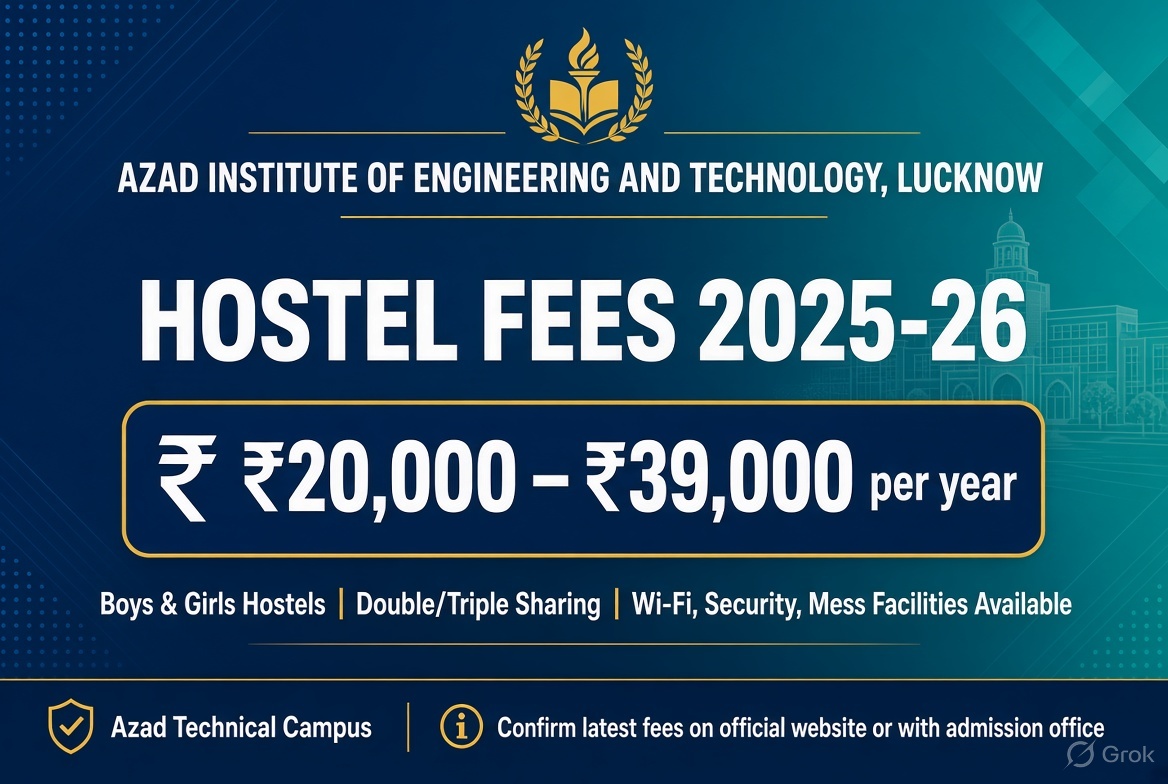
AIET Lucknow's hostel fees range from about INR 20,000 to 50,000 annually depending on room type, with separate mess charges billed monthly. Boys' and girls' hostels are split by academic year across two blocks each.
⚡ Quick Answer
AIET Lucknow charges an annual hostel fee of roughly INR 20,000 to 50,000 for shared-occupancy rooms across its separate boys' and girls' hostels. Mess charges are billed separately on a monthly basis and are not included in this fee.
📌 Key Takeaways
- Annual hostel fee at AIET Lucknow ranges from approximately INR 20,000 to 50,000 Separate hostel blocks exist for boys and girls, split by academic year Rooms are shared, typically housing 2–3 students each Hostel fee covers accommodation, basic furniture, Wi-Fi, security, and common areas Mess/food charges are billed separately on a monthly basis Scholarships can reduce overall fee burden but don't directly cover hostel costs Hostel seats are limited, so early application after admission is recommended
Azad Institute of Engineering and Technology, popularly known as AIET Lucknow, is one of the well-established private engineering colleges in Uttar Pradesh. Founded in 1998, the institute is affiliated with Dr. A.P.J. Abdul Kalam Technical University (AKTU), approved by AICTE, and accredited by the National Board of Accreditation (NBA). Located at Azad Technical Campus, Azadpuram, Chandrawal, near Bijnour and Charbagh Railway Station, the college is part of the larger Azad Group of Educational Institutions and offers undergraduate and postgraduate programmes in engineering, management, and computer applications.
For students coming to Lucknow from other cities and districts, on-campus hostel accommodation is one of the most important considerations while planning admission. This article gives a detailed overview of the AIET Lucknow hostel fee structure, room types, facilities, eligibility, and everything else prospective students and parents need to know before applying for hostel accommodation.
<iframe src=”https://www.google.com/maps/embed?pb=!1m18!1m12!1m3!1d3016.050095136543!2d80.8908653!3d26.725887399999998!2m3!1f0!2f0!3f0!3m2!1i1024!2i768!4f13.1!3m3!1m2!1s0x399bf98f87df162f%3A0x1eba69f26bd72988!2sAzad%20Group%20of%20Educational%20Institutions!5e1!3m2!1sen!2sin!4v1789309656134!5m2!1sen!2sin” width=”600″ height=”450″ style=”border:0;” allowfullscreen=”” loading=”lazy” referrerpolicy=”strict-origin-when-cross-origin”></iframe>
1. AIET Lucknow at a Glance
| Particulars | Details |
|---|---|
| Institute Name | Azad Institute of Engineering and Technology (AIET) |
| Established | 1998 |
| Location | Azad Technical Campus, Azadpuram, Chandrawal, near Bijnour, Lucknow |
| Affiliation | Dr. A.P.J. Abdul Kalam Technical University (AKTU) |
| Approval | AICTE |
| Accreditation | NBA |
| Courses Offered | B.Tech, B.Tech (Lateral), M.Tech, MBA, MCA, Diploma |
| Hostel Facility | Separate hostels for boys and girls |
| Nearest Railway Station | Charbagh Railway Station |
2. Overview of AIET Lucknow Hostel Facility
AIET Lucknow operates separate hostel blocks for male and female students within the Azad Technical Campus, ensuring that outstation students have a safe and convenient place to stay close to their academic departments. The campus houses two boys’ hostels and two girls’ hostels catering to students across different years of study.
2.1 Hostel Blocks and Year-Wise Segregation
The boys’ hostel arrangement includes a general “Azad Boys Hostel,” which primarily accommodates second, third, and final-year male students, and a separate “New Azad Boys Hostel” reserved for first-year students. Together, these two hostel blocks can house several hundred boys, making them among the larger hostel setups among private engineering colleges in the Lucknow region.
Similarly, the girls’ hostel is divided into the “Abdul Kalam Girls Hostel,” meant for second, third, and final-year female students, and the “New Abdul Kalam Girls Hostel,” designated for first-year girls. These two blocks together provide accommodation to several hundred female students, with dedicated security arrangements in place.
2.2 Hostel Capacity Summary
| Hostel Block | Meant For | Approximate Capacity |
|---|---|---|
| Azad Boys Hostel | 2nd, 3rd, and 4th year boys | Part of combined ~600 capacity |
| New Azad Boys Hostel | 1st year boys | Part of combined ~600 capacity |
| Abdul Kalam Girls Hostel | 2nd, 3rd, and 4th year girls | Part of combined ~500 capacity |
| New Abdul Kalam Girls Hostel | 1st year girls | Part of combined ~500 capacity |
This division by academic year helps the institute manage orientation and settling-in requirements for freshers separately from senior students, while also making hostel administration and mess planning easier.
3. AIET Lucknow Hostel Fee Structure
Hostel fees at AIET Lucknow are charged on an annual basis and are separate from the tuition fee charged for academic courses. Based on available fee structures published by the institute and various education information portals, the annual hostel fee at AIET Lucknow generally falls in the range of approximately INR 20,000 to INR 50,000 per year, depending on the type of room, occupancy pattern, and facilities included.
3.1 Indicative Annual Hostel Fee Range
| Category | Approximate Annual Fee (INR) |
|---|---|
| Standard shared room (basic furnishing) | 20,000 – 30,000 |
| Shared room with better furnishing/fewer occupants | 30,000 – 40,000 |
| Premium/well-furnished room | 40,000 – 50,000 |
| Boys’ Hostel (overall range) | 20,000 – 50,000 |
| Girls’ Hostel (overall range) | 20,000 – 50,000 |
3.2 Points to Note on Fee Variation
- Basic shared-occupancy rooms with standard furnishings tend to fall on the lower end of this range, closer to INR 20,000–30,000 annually.
- Rooms with better furnishing, fewer occupants per room, or additional amenities may be charged closer to INR 40,000–50,000 annually.
- The fee structure is broadly similar for both male and female students, though minor variations can exist depending on the specific hostel block and the facilities provided within it.
- Hostel fees are typically payable either as a lump sum at the start of the academic year or in installments aligned with semester fee payment schedules, depending on the policy communicated by the college administration for that academic session.
It is important to remember that hostel fee figures published on third-party education portals are indicative and may change from year to year. Prospective students are strongly advised to confirm the latest, officially notified hostel fee directly from the AIET Lucknow admission office or the official college website before making any payment or financial commitment, since fee structures are revised periodically by the institute’s administration.
4. What the Hostel Fee Typically Covers
While the exact inclusions can vary depending on the hostel block and the specific package a student opts for, the annual hostel fee at AIET Lucknow generally covers several components.
4.1 Inclusions in the Hostel Fee
| Component | Included in Base Hostel Fee? | Notes |
|---|---|---|
| Room/accommodation charges | Yes | Shared occupancy, 2–3 students per room |
| Basic furniture (bed, table, wardrobe) | Yes | Provided per occupant |
| Electricity & water (common use) | Usually Yes | May be charged on actuals in some cases |
| Internet/Wi-Fi access | Yes | Available in rooms/common areas |
| Security services | Yes | Guards posted at hostel gates |
| Common area maintenance | Yes | Corridors, common rooms, recreational areas |
| Mess/food charges | No (Separate) | Billed monthly, in addition to hostel fee |
| Laundry services | Not standard | May need to be arranged privately |
Mess or dining charges are usually billed separately from the core hostel accommodation fee, and students should budget for this as an additional monthly or semester-wise expense. The mess facility is generally reserved exclusively for hostel residents and operates on a fixed monthly charge basis, which is communicated separately from the annual hostel accommodation fee.
5. Room Types and Occupancy
AIET Lucknow’s hostel blocks are primarily structured around shared occupancy, which is a common arrangement across most private engineering colleges in India to keep hostel fees affordable for a wider base of students.
5.1 Room Occupancy Options
| Room Type | Occupants per Room | Relative Fee Level | Availability |
|---|---|---|---|
| Standard shared room | 2–3 students | Lower to mid-range | Widely available |
| Smaller shared room | 2 students | Mid to higher range | Limited |
| Single-occupancy room | 1 student | Highest (on enquiry) | Very limited, subject to availability |
The total capacity across the hostel blocks is substantial, with combined boys’ hostel accommodation designed for several hundred students and a similarly sized capacity on the girls’ side. This scale reflects the significant proportion of the student body that comes from outside Lucknow city and depends on institutional accommodation rather than private rented housing.
Students who prefer more private accommodation, such as single-occupancy rooms, should directly enquire with the hostel warden or admission office, as such options—if available—are usually limited in number and may carry a higher fee than the standard shared rooms.
6. Hostel Infrastructure and Amenities
Beyond the basic room furnishings, AIET Lucknow’s hostel campus is designed to offer students a reasonably comfortable residential experience alongside their academics.
6.1 Common Facilities Available
| Facility | Description |
|---|---|
| Recreational amenities | Indoor games, TV areas, access to campus sports complex |
| Sports complex access | Includes reported swimming pool and outdoor sports grounds |
| Common study/gathering areas | Spaces for revision and student interaction |
| Security personnel | Round-the-clock guards at hostel gates and blocks |
| Proximity to academic blocks | Hostels located within the same campus as classrooms and labs |
| Surroundings | Relatively green, low-pollution campus location |
At the same time, prospective residents should be aware that some accounts of the hostel infrastructure describe it as functional but not always up to the standard of newly built private hostels, with occasional feedback about overall building upkeep. Students and parents visiting the campus for admission counselling are encouraged to personally inspect the hostel blocks before finalizing their decision, so they can assess the current condition of rooms, washrooms, and common areas firsthand.
7. Mess and Food Arrangements
The hostel mess at AIET Lucknow operates separately for hostel residents and is designed to provide daily meals covering breakfast, lunch, and dinner. Mess charges are billed on a periodic basis—commonly monthly—and are distinct from the annual hostel accommodation fee.
7.1 Mess Charge Snapshot
| Item | Details |
|---|---|
| Billing cycle | Monthly (typically) |
| Meals covered | Breakfast, lunch, dinner |
| Eligibility | Exclusively for hostel residents |
| Included in hostel fee? | No, charged separately |
| Special dietary needs | To be discussed with hostel administration |
Students opting for hostel accommodation should factor in this recurring mess expense while planning their overall annual budget, since it adds a meaningful amount on top of the base hostel fee. As with any institutional mess service, meal quality and variety can differ from student expectations at times, and the college periodically reviews mess arrangements based on feedback from the student hostel committee.
8. Total Cost of Attendance: Hostel Fee in Context
To understand the complete cost of studying and residing at AIET Lucknow, it helps to see hostel fees alongside tuition fees.
8.1 Approximate Annual Cost Breakup (Illustrative)
| Cost Head | Approximate Annual Amount (INR) |
|---|---|
| B.Tech Tuition Fee (1st year) | ~50,000 |
| Hostel Fee | 20,000 – 50,000 |
| Mess Charges (billed separately) | Variable, monthly basis |
| Total B.Tech Course Fee (4 years, all specializations) | 1,20,000 – 2,44,800 (approx., entire duration) |
When hostel fees and mess charges are added to tuition cost, the total annual expenditure for an outstation student living in the hostel becomes noticeably higher than for a day scholar. However, this combined cost still tends to remain competitive compared to many private hostels and paying-guest accommodations available in Lucknow city, which is one reason the on-campus hostel option remains attractive for students coming from outside the city.
9. Scholarships and Fee Concessions
AIET Lucknow, in line with many AKTU-affiliated institutions, offers merit-based and government-backed scholarship schemes that can help offset the overall cost of education, including indirectly easing the financial burden of hostel stay.
9.1 Types of Scholarships Available
| Scholarship Type | Who It Is For | Impact on Overall Cost |
|---|---|---|
| Government/Merit Quota benefits | Students admitted under government quota | Lower overall fee burden |
| National/Minority Scholarship Schemes | Eligible minority community students | Partial reimbursement of tuition-related costs |
| Academic Merit-Based Scholarships | High-performing students | Reduction in tuition fee component |
| Need-Based Financial Aid | Economically weaker students (subject to eligibility) | Helps manage overall fee, including indirect hostel cost pressure |
While these scholarships are generally aimed at academic fee components rather than hostel charges specifically, the overall reduction in a student’s total fee burden can make it easier to manage hostel and mess expenses within a family’s budget. Students interested in availing of any scholarship scheme should check eligibility criteria and application deadlines through the official scholarship portals and the AIET Lucknow admission or scholarship cell.
10. How to Apply for Hostel Accommodation
Hostel allotment at AIET Lucknow is generally handled after a student secures admission to an academic programme through the applicable counselling process, whether via UPTAC counselling for AKTU-affiliated seats or through the management quota.
10.1 Step-by-Step Hostel Application Process
| Step | Action |
|---|---|
| Step 1 | Confirm academic admission through UPTAC counselling or management quota |
| Step 2 | Submit a separate hostel application form (available at/after admission) |
| Step 3 | Indicate hostel block preference and any special requirements |
| Step 4 | Pay the applicable hostel fee as per the communicated payment schedule |
| Step 5 | Submit supporting documents (ID proof, guardian contact details, local guardian info if required) |
| Step 6 | Receive hostel room allotment confirmation from the hostel office |
Since hostel seats are limited relative to the total student intake, it is advisable for outstation students to apply for hostel accommodation as early as possible after confirming their admission, to improve the chances of securing a room in the preferred hostel block.
11. Key Takeaways
AIET Lucknow offers a fairly standard hostel accommodation setup for a private engineering college of its size, with separate, year-wise segregated hostel blocks for boys and girls, annual hostel fees generally in the range of INR 20,000 to 50,000, and additional mess charges billed separately. The hostel fee typically covers accommodation, basic furnishing, internet access, security, and common area maintenance, while offering access to campus-wide recreational facilities.
For students and parents evaluating whether the AIET Lucknow hostel is the right choice, it is worth weighing the fee against the total cost of alternative accommodation options in Lucknow, confirming the latest fee figures directly with the institute, and visiting the hostel premises in person wherever possible before finalizing a decision. As fee structures are subject to periodic revision, always cross-check the current year’s exact hostel fee notification from the official AIET Lucknow website or admission office rather than relying solely on previously published figures.
Helpful answers
Frequently asked questions
What is the annual hostel fee at AIET Lucknow?
The annual hostel fee at AIET Lucknow generally ranges from approximately INR 20,000 to INR 50,000, depending on the room type, occupancy, and facilities included.
Does AIET Lucknow have separate hostels for boys and girls?
Yes. AIET Lucknow has two boys' hostel blocks (Azad Boys Hostel and New Azad Boys Hostel) and two girls' hostel blocks (Abdul Kalam Girls Hostel and New Abdul Kalam Girls Hostel), segregated by academic year.
Are mess charges included in the AIET Lucknow hostel fee?
No. Mess and food charges are billed separately from the annual hostel accommodation fee, typically on a monthly basis.
How many students share a room in the AIET Lucknow hostel?
Most rooms are shared and accommodate 2 to 3 students each. Single-occupancy rooms may be available on request but are limited and usually cost more.
What facilities are included in the hostel fee at AIET Lucknow?
The hostel fee typically covers accommodation, basic furniture (bed, table, wardrobe), electricity and water for common use, Wi-Fi access, security, and maintenance of common areas.
Is the AIET Lucknow hostel fee the same for boys and girls?
The fee structure is broadly similar for both, though it can vary slightly depending on the specific hostel block and the facilities provided within it.
How do I apply for hostel accommodation at AIET Lucknow?
After confirming academic admission through UPTAC counselling or the management quota, students submit a separate hostel application form, indicate their hostel preference, pay the applicable fee, and complete the required documentation.
Are scholarships available to reduce the hostel fee at AIET Lucknow?
Scholarships at AIET Lucknow are mainly aimed at tuition fees rather than hostel charges directly, but reducing the overall fee burden through merit or government scholarships can make it easier to manage hostel and mess costs.
Where can I confirm the latest hostel fee for AIET Lucknow?
Since hostel fees are revised periodically, it's best to confirm the current year's exact fee directly with the AIET Lucknow admission office or the official college website rather than relying on previously published figures.
Reader feedback