
Minimum Percentage Required for Australia After 12th
Australia has no single minimum percentage after Class 12, because each university and course sets its own cut-off. Pathway and diploma programs start at about 50-60%, most bachelor's degrees need 60-75%, and competitive courses at top universities usually need 80-90%. You also need IELTS 6.0-6.5 or higher, the right subject prerequisites and a successful student visa application.
⚡ Quick Answer
Australia has no single minimum percentage after Class 12. Each university sets its own cut-off. Pathway and diploma programs start at about 50–60%, most bachelor's degrees at mid-ranked universities need 60–75%, and competitive courses at top universities usually need 80–90%, plus IELTS 6.0–6.5 or higher.
📌 Key Takeaways
- There is no national minimum; every university and course sets its own cut-off. 60–65% is the usual floor for a bachelor's degree, but 70–85% is where most offers land. Group of Eight universities realistically expect 80–90% for engineering, commerce, law and health courses. Below 60%, a foundation or pathway program is the practical route into a degree. Subject prerequisites (maths, physics, chemistry, biology) can block you even with a good percentage. IELTS or an equivalent English test is a second gate, usually 6.0–6.5 overall with no band below 5.5–6.0. A university offer does not guarantee a student visa; the Genuine Student test and financial proof decide it. Parents should calculate total cost over the full degree and get the visa-refusal refund policy in writing.
A practical guide for students and parents planning Australia after Class 12
Students: this tells you which universities and courses your marks can realistically reach. Parents: this tells you what you are actually committing to, in marks, money and visa risk, before you pay anyone a fee.
There is no single national minimum. Australia has no central admission body for international students, so every university and every course sets its own cut-off.
That said, the numbers cluster in a predictable range:
- 50–60%: Foundation programs and some pathway colleges.
- 60%: Diploma entry (Deakin College, for example, lists 60% for its Diploma).
- 60–65%: The usual floor for a bachelor’s degree at mid-ranked universities.
- 70–85%: Where most mainstream courses at good universities actually land.
- 85–90%+: Competitive courses at the Group of Eight (Melbourne, Sydney, UNSW, ANU, Monash, Queensland, Adelaide, UWA), especially engineering, commerce, law and anything health-related.
If you scored 65%, you are not locked out of Australia. You are locked out of some universities and some courses. Knowing which ones is the whole game.
Why you see different numbers everywhere
Search this topic and you will find 60%, 65%, 70% and 75% all stated as “the minimum.” None of them is wrong. They describe different things.
Some sites quote the lowest cut-off across all universities. Some quote the typical cut-off for a bachelor’s degree. Some quote what a competitive applicant needs. Most of these pages are written by education agents, who earn commission when you enrol, so they tend to round numbers toward whatever makes you feel admission is easy.
The only figure that matters for you is the one on your target course page on the university’s own website, under “India” or “international entry requirements.” Everything in this guide is a map. The university page is the territory.
How Australian universities read your Class 12 marks
Australian universities do not convert your percentage the way you might expect. Three things matter.
1. Which subjects count. Many universities calculate an average across your best graded academic subjects, not the full marksheet. Some exclude subjects like Physical Education or work experience subjects. RMIT, for instance, maps your average across graded academic subjects to an Australian equivalent on a roughly one-to-one scale. A 65% average gives you a 65-equivalent, and a 90% average gives you a 90-equivalent.
2. Subject prerequisites. Your overall percentage can be fine and you can still be rejected if you lack the required subjects. Engineering and science courses usually require mathematics, and often physics or chemistry. Commerce degrees may require maths. Health courses typically want biology and chemistry. Check the prerequisites before the percentage.
3. Which board you studied under. CBSE, CISCE (ICSE/ISC) and state board results are all recognised for undergraduate entry. Universities do treat boards a little differently. Some publish separate cut-offs for CBSE/ISC and for state boards, and state board students sometimes face a slightly higher bar or an additional requirement. If you are on a state board, confirm this explicitly rather than assuming parity.
Minimum percentage by type of institution
Group of Eight universities
Expect 80–90% as a realistic target for most courses, and higher for the hardest ones. Published minimums can look lower than that, but published minimums are not the same as what gets offers. Where demand exceeds places, the actual intake is made up of students well above the minimum.
If you scored under 75%, applying directly to a Go8 bachelor’s degree is usually a poor use of your application fees. A better route is a pathway program, covered below.
Mid-ranked and regional universities
This is where 60–75% works for most courses. Universities such as Deakin, RMIT, La Trobe, Swinburne, Griffith, Western Sydney, Macquarie, UTS and several others accept students in this band for a wide range of degrees. Some courses, such as IT, business, and arts, are more accessible. Others, such as engineering at certain universities, stay selective.
A reported 65% minimum average for bachelor’s degrees at RMIT, rising toward 70–90% for selective programs, is a fair example of how this tier is structured.
Pathway colleges and foundation programs
These are run by or in partnership with universities. Deakin College, for example, lists Year 12 at 60% for its Diploma program, and assesses Foundation entry case by case. Others take students from around 50%. You study a year (or two semesters of a diploma), then move into the second year of the degree or first year with credit.
This is the most practical route for anyone in the 50–65% range who wants a degree from a strong university.
VET and TAFE
Vocational courses (Certificates and Diplomas) often have lower or no strict percentage requirements, with the focus on English and genuine student assessment. They are cheaper and shorter, but the career and visa outcomes are very different from a degree. More on that below.
Minimum percentage by course
These are typical ranges, not guarantees. Always verify.
| Course area | Typical Class 12 range | Prerequisites to check |
|---|---|---|
| Business / Commerce | 65–80% | Maths sometimes required |
| Information Technology / Computer Science | 65–80% | Maths usually required |
| Engineering | 70–85% | Maths plus physics and/or chemistry |
| Science | 65–80% | Subject-specific |
| Nursing and allied health | 65–80% | Often biology/chemistry, plus English test and placement checks |
| Law (undergraduate) | 75–90% | Varies |
| Architecture and design | 70–85% | Portfolio sometimes required |
| Medicine | Extremely high, plus UCAT/interview | Very few international places |
Medicine deserves a blunt note. Undergraduate medicine places for international students are very limited and very competitive, and they come with admissions tests and interviews on top of near-perfect marks. If that is your goal, a percentage chart will not help you. Talk to the specific university’s international admissions office early.
The English requirement is a second gate
Students spend months worrying about percentage and then get stuck on English.
For undergraduate degrees, the common requirement is an IELTS Academic score of 6.0 to 6.5 overall, with no band below 5.5 or 6.0. The University of Sydney, for example, sets a standard of IELTS 6.5 overall with no band below 6.0. Courses like nursing, education and law can require higher scores, sometimes 7.0.
PTE Academic, TOEFL iBT and the Duolingo English Test are accepted by many universities, though not all accept all of them. Some universities waive the English test if you scored a high mark in English in Class 12, but this is not universal, and the required English mark is often stricter than your overall percentage.
If your English is weak, an English pathway (ELICOS) combined with a degree offer can be arranged. It adds cost and time, so only choose it if you actually need it.
What if your percentage is below 60%?
Be realistic. You have fewer options, but you have some.
Foundation or pathway diploma. Some providers accept students from around 50%. This is the main door open to you for a degree-level outcome.
Improve your marks first. If you can improve through a board improvement attempt or by retaking subjects, one more year may open far better options than rushing into a weak course.
Consider a different route entirely. Studying in India for a bachelor’s degree with a good score and applying to Australia for a master’s later is a legitimate path, and often cheaper.
Avoid the lowest-tier shortcuts. If someone promises admission with any percentage and no English test, treat that as a warning sign. Courses chosen purely because the entry bar is low are the ones most likely to run into visa trouble, weak job outcomes, or both.
The visa is a separate hurdle from admission
An offer letter does not guarantee a student visa. Admission and visa are decided by different bodies using different criteria.
What to know:
- Genuine Student requirement. Since 2024, applicants must show a genuine intention to study, replacing the older Genuine Temporary Entrant test. You are asked about your circumstances, why this course, why Australia, and your plans afterward. Generic answers get refused.
- Financial capacity. You must show you can cover tuition, living costs and travel. The living-cost benchmark has risen sharply in recent years, and at the last check it was roughly AUD 30,000 per year for the main applicant. Check the Department of Home Affairs for the current figure.
- High fees and tighter limits. The student visa application fee has increased substantially, and the government has applied caps on new international enrolments through national planning levels. Universities are managing their allocations, which has made some courses more selective than their published cut-offs suggest.
- Assessment levels. India is not in the lowest-risk assessment group, which means more documentary evidence is expected. Weak financial documents are a common cause of refusal.
- Use a CRICOS-registered course. Your course and provider must be registered. You can verify this on the official CRICOS site.
These rules change often. Confirm everything on the Department of Home Affairs website before you pay any fees.
A realistic plan, step by step
Step 1: Fix your numbers. Calculate your best-subjects average, not just your total percentage. Note your English score and your subject combination.
Step 2: Sort universities into three tiers. Pick a few reach options, a few likely options, and at least two safe options, including at least one pathway program.
Step 3: Read each course page, not a blog. Look for the India-specific entry requirement, the prerequisites, the English score, and the application deadline.
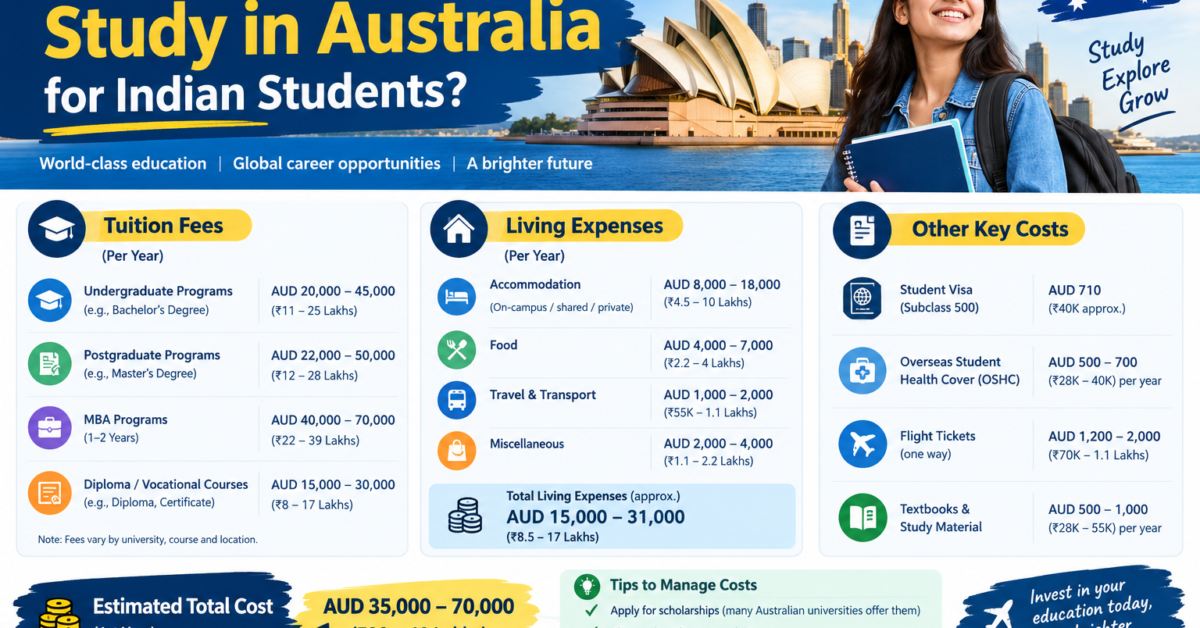
Step 4: Check the real cost. Tuition for undergraduate degrees often falls in the range of roughly AUD 30,000 to 50,000 a year depending on the course, and more for medicine and some other fields. Add living costs, OSHC (mandatory health cover), and flights. Compare this with your family’s real budget, not the optimistic version.
Step 5: Take the English test early. A retake takes time, and you do not want your offer held up because of one band.
Step 6: Apply, then prepare for the visa. Prepare your Genuine Student statement and financial documents while your application is still being processed, not after the offer arrives.
Common mistakes
- Treating the lowest number you saw online as your target. Minimum is not the same as likely to be accepted.
- Ignoring prerequisites. A 78% with no maths is less useful than a 70% with maths for many courses.
- Choosing by cut-off alone. An easy-entry course in a field with poor job prospects is a bad deal at AUD 100,000 or more in total cost.
- Relying on one agent. Agents can be useful for paperwork, but they are paid by providers. Cross-check what they tell you against university websites.
- Leaving English to the end. It is the most common avoidable delay.
- Underestimating the budget. Running out of money mid-degree is a real risk, and part-time work is limited and not guaranteed.
- Starting too late. Applications for the main intakes open months ahead. Late applicants lose offers and scholarship rounds.
Scholarships and your percentage
High marks do more than help you get in. Many universities offer merit-based scholarships to international students based on Class 12 results, usually reducing tuition by a percentage or a fixed amount. They are competitive, and many require a separate application or are awarded automatically with your offer. If you have 85% or above, check each university’s scholarship page before you decide, because a partial discount can change which options are affordable.
For parents: check these before paying anything
Admission is the easy part. The money and the visa are where families get hurt.
- Work out the total, not the first-year fee. Tuition is often AUD 30,000–50,000 a year, and living costs are roughly AUD 30,000 a year on top. A three-year degree commonly costs well over AUD 150,000 once health cover and flights are added. Convert that at the current exchange rate and compare it with what you can pay without selling assets in a hurry.
- If you are taking an education loan, ask the bank for the repayment schedule, the interest rate, and what happens if your child cannot find work quickly. Do not assume part-time income will cover repayments. Student work hours are capped during term (check the current limit on the Home Affairs site), and jobs are not guaranteed.
- Ask the university what happens if the visa is refused. Get the refund policy in writing before you pay a deposit or first-semester tuition.
- Treat “guaranteed visa” as a red flag. No agent controls visa decisions. Ask for the agent’s fees in writing, and check that the university lists them as an authorised representative on its own website.
- Do not arrange last-minute funds. Money that appears in an account just before the visa application can look like what it is. Visa officers check how funds were built up over time.
- Let your child do the research. The visa interview-style questions and the Genuine Student statement are about the student’s own reasons. Answers that sound written by an agent or a parent are a common cause of refusal.
- Plan for the bad case. Decide now what the family will do if the first year goes poorly: a course change, a return to India, or a transfer to a cheaper provider. Having that conversation in advance is cheaper than having it in Sydney or Melbourne in month eight.
For students: your part is simple. Know your best-subjects average, book the English test early, and be able to explain in your own words why this course and why Australia.
Is it worth it with a low percentage?
The honest answer depends on the course, not the country. A 62% student who enters a pathway program, performs well, and transfers into a solid degree at a good university can end up in a strong position. A 62% student who takes the cheapest course at the first provider that accepts them is taking on the same cost with far weaker outcomes.
If your goal is a skilled job and eventually post-study work rights, choose a degree in a field where graduates are actually hired, at a provider with decent employer recognition, and make sure you can afford all of it without gambling on part-time income.
Quick reference
| Your Class 12 score | Realistic options |
|---|---|
| Below 50% | Retake/improve, VET, or study in India first |
| 50–59% | Foundation or pathway programs |
| 60–64% | Diploma pathways, some mid-tier bachelor’s courses |
| 65–74% | Many bachelor’s programs at mid-ranked universities |
| 75–84% | Wide choice, some Go8 courses with strong subjects |
| 85%+ | Competitive Go8 programs plus scholarship eligibility |
Final word
The minimum percentage is not a pass mark. It is the floor below which your application is not considered. The real question is what percentage gets you the course you want, at a price you can afford, in a field that leads to work. Start with the course page, check your subjects and English score, and build a shortlist with realistic tiers. Then verify every number directly with the university and the Department of Home Affairs before you commit any money.
Helpful answers
Frequently asked questions
Is 60% enough for Australia after 12th?
Yes for diploma and pathway programs at many providers, such as Deakin College’s 60% Year 12 requirement. For a direct bachelor’s degree, 60% works only at some universities and courses. Most mainstream degrees expect 65–75%, so your choice will be limited. Check the specific course page and prerequisites before applying.
Can I study in Australia with 50% in Class 12?
Possibly, but not directly into a degree. Some foundation programs and vocational courses accept students from around 50%. A foundation year can lead into a bachelor’s degree if you pass it well. Improving your marks first, or studying in India before applying for a master’s, may give you better options.
Do all Australian universities need the same Class 12 percentage?
No. Australia has no central admission system for international students, so each university and each course sets its own cut-off. Requirements also differ by board, subject combination and English score. Always use the India entry requirements on the university’s own course page, not a figure from a blog or agent.
What Class 12 percentage do top Australian universities expect?
Group of Eight universities such as Melbourne, Sydney, UNSW and Monash realistically expect 80–90% for most courses, and higher for engineering, law, commerce and health programs. Published minimums can look lower, but offers usually go to students well above them. Scores under 75% are usually better directed to pathway programs.
Is IELTS compulsory for Australian universities?
Most universities require an English test for undergraduate entry, usually IELTS Academic 6.0 to 6.5 overall with no band below 5.5 or 6.0. PTE, TOEFL and Duolingo are accepted by many. Some universities waive the test for high Class 12 English marks, but never assume a waiver without written confirmation.
Do subject requirements matter as much as percentage?
Yes, often more. Engineering, IT and science courses commonly require mathematics, and sometimes physics or chemistry. Health courses usually want biology and chemistry. A 78% without the required subject can be rejected while a 70% with it is accepted. Always check prerequisites on the course page before you shortlist universities.
Does a high percentage guarantee an Australian student visa?
No. Admission and visa are decided separately. Even with excellent marks, you must pass the Genuine Student assessment, show enough funds for tuition and living costs, and provide accurate documents. Weak financial evidence and generic answers are common refusal reasons, so prepare your statement and finances alongside your university application.
How much does it cost to study in Australia after 12th?
Undergraduate tuition is often AUD 30,000 to 50,000 a year, with medicine and some fields higher. Living costs add roughly AUD 30,000 a year, plus health cover and flights. A three-year degree commonly exceeds AUD 150,000. Confirm current figures with the university and the Home Affairs website before paying anything.
Is a foundation program worth it if my marks are low?
Yes, if your marks fall below your target university’s requirement. A foundation or diploma pathway lets you enter a degree, often into first or second year, after one year of study. It costs extra, so confirm in writing which degrees it guarantees entry to and what grades you must achieve.
What should parents check before paying an agent or university?
Get the total cost in writing first. Ask the university for its refund policy if the visa is refused. Verify the agent on the university’s own website, and reject any “guaranteed visa” promise. Compare loan repayments with realistic income, because student work hours are capped and part-time jobs are never guaranteed.