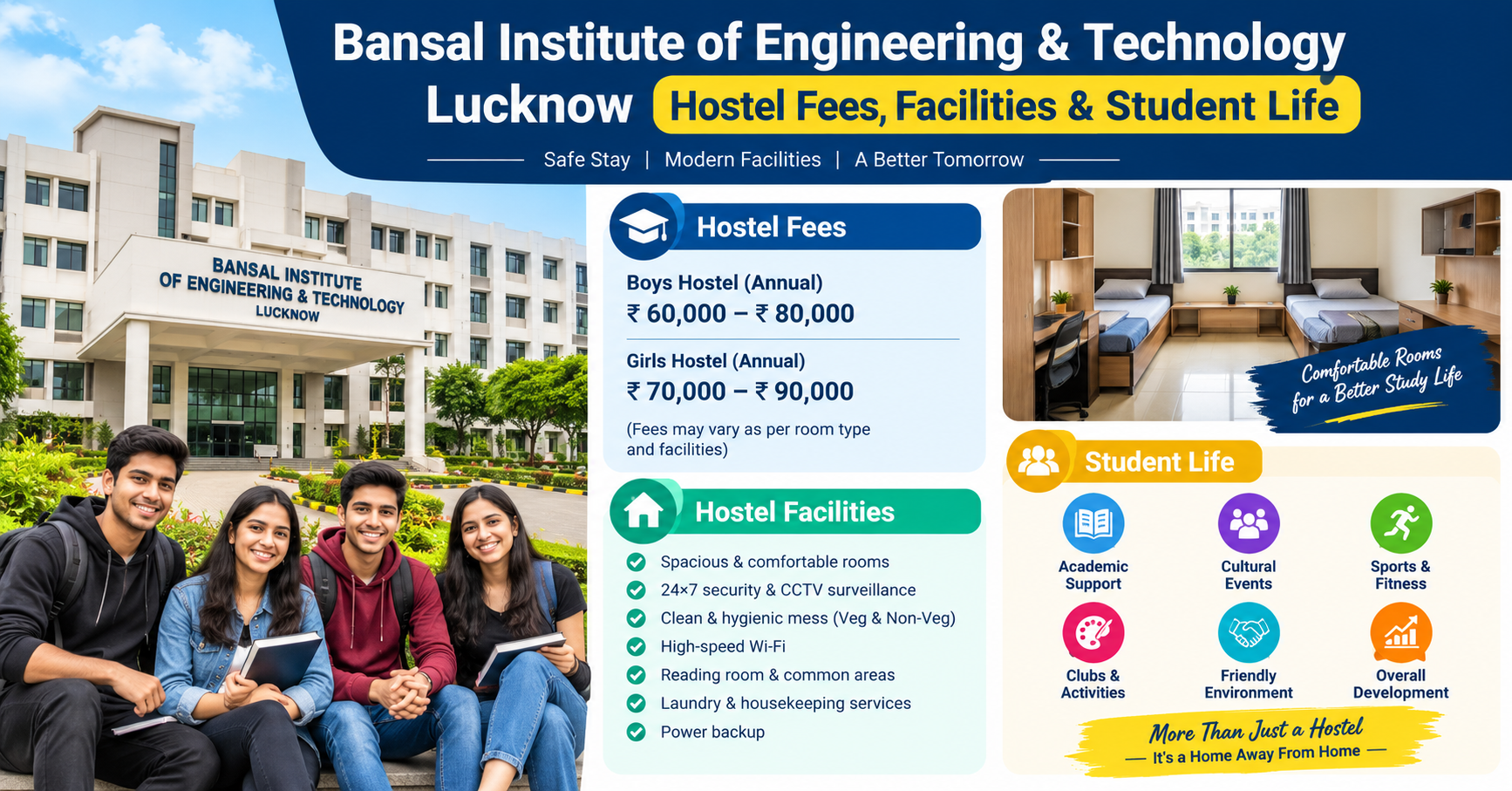
Bansal Institute of Engineering & Technology Lucknow Hostel Fees Facilities & Student
BIET Lucknow hostel fees are ₹60,000 per year for non-AC twin-sharing and ₹80,000 per year for AC twin-sharing rooms (mess included). Separate on-campus hostels for boys (≈400 beds) and girls (≈100 beds) provide basic furnished rooms, Wi-Fi, 24/7 electricity and water. A one-time refundable security deposit of around ₹5,000 is usually charged.
⚡ Quick Answer
BIET Lucknow hostel fees for 2025-26 are ₹60,000 per year for non-AC twin-sharing and ₹80,000 per year for AC twin-sharing rooms. Both options include mess charges. A one-time refundable security deposit of approximately ₹5,000 is usually required. Separate hostels for boys (≈400 beds) and girls (≈100 beds) are available on campus.
📌 Key Takeaways
- Non-AC twin-sharing hostel + mess costs ₹60,000 per year AC twin-sharing hostel + mess costs ₹80,000 per year Mess charges are included in the annual hostel fee Boys’ hostel capacity is around 400 beds; girls’ hostel around 100 beds Rooms come with bed, table, chair, wardrobe and 24/7 electricity & water Security deposit is approximately ₹5,000 (refundable) Hostel allotment is generally first-come, first-served during admission Food is described by students as average to satisfactory with a rotating menu Outing timings are restricted and discipline is moderately strict Fees have remained stable in recent years compared to other private colleges in Lucknow
After more than a decade of closely following engineering colleges across Uttar Pradesh—advising families, reviewing student feedback year after year, and tracking fee structures—I can say with confidence that hostel decisions often matter as much as the academic program itself. For many students coming to Lucknow from smaller towns or other states, the hostel becomes their home for four years. At Bansal Institute of Engineering & Technology (BIET), located on NH-24 Sitapur Road behind Sewa Hospital, the hostel offering is straightforward, relatively affordable by current private-college standards, and designed for focused student life rather than luxury.
Current Hostel Fee Structure (Most Reliable Figures)
According to the institute’s own Mandatory Disclosure documents and consistent reporting across multiple education portals (Collegedunia, CollegeDekho, KollegeApply, and student reviews), the annual boarding and lodging charges for the 2024-25 / 2025-26 cycle stand as follows:
- Non-Air Conditioned Twin Sharing: ₹60,000 per year (accommodation + mess/fooding included)
- Air Conditioned Twin Sharing: ₹80,000 per year (accommodation + mess/fooding included)
A one-time refundable security deposit of around ₹5,000 is commonly mentioned. Fees are generally payable annually or in instalments (semester-wise options exist according to some student accounts). There is no major difference in published rates between boys’ and girls’ hostels.
These figures have remained stable for the last couple of years. Earlier secondary sources sometimes listed a flat ₹55,000–60,000 range with mess included and occasional mention of triple-sharing options near ₹55,000, but the official disclosure and recent aggregators converge clearly on the ₹60,000 (non-AC) / ₹80,000 (AC) twin-sharing model. Always verify the exact amount and payment schedule at the time of admission, as minor revisions or additional charges (electricity surcharge in extreme summers, for example) can appear.
For a four-year B.Tech programme, a student opting for non-AC accommodation can therefore expect roughly ₹2.4 lakh in total hostel expenditure (excluding personal expenses). Choosing AC adds another ₹80,000 over the duration. Compared with many private institutes in the Lucknow–Kanpur belt where hostel + mess packages now regularly cross ₹90,000–1.1 lakh, BIET remains on the more economical side.
Room Types, Capacity & Basic Amenities
Boys’ hostel capacity is reported around 400 beds; girls’ hostel is smaller, approximately 100 beds. Accommodation is primarily twin-sharing. Rooms come furnished with the essentials: bed, mattress, study table, chair, wardrobe/almirah, and fan (plus air-conditioning in the higher category). 24-hour electricity and clean water supply are standard claims, supported by most student reviews.
Wi-Fi is available in the hostels (campus internet is listed at 100–200 Mbps in recent institute material). Laundry facilities, common rooms, indoor games areas, and basic recreational spaces exist. Medical support includes an infirmary and tie-ups with nearby hospitals (Sewa Hospital is literally next door). Wardens are present, and security is described as round-the-clock with restricted entry/exit timings—typical for residential engineering campuses in the region.
Students repeatedly note that rooms are clean and functional rather than luxurious. Space is adequate for two people to study and store belongings. Power backup and water availability receive generally positive mentions, which is important in Lucknow’s summer heat and occasional municipal supply fluctuations.
Mess & Food Experience
Mess charges are bundled into the annual hostel fee. The mess typically serves four meals a day with a rotating menu. Student feedback is mixed but realistic: food is described as “satisfactory,” “decent,” “hygienic kitchen,” or “average—sometimes oily/spicy.” A daily changing menu helps avoid monotony, yet expectations of home-style cooking or restaurant variety should be kept moderate. Canteen options on campus provide additional variety for snacks and evening tea.
In my experience guiding students, mess satisfaction is highly individual. Those who adapt to standard North Indian hostel fare (dal, roti, sabzi, rice, occasional specials) settle in quickly. Others who are particular about regional cuisine or very light food often keep a small personal stash or use the canteen. Hygiene standards appear acceptable based on the bulk of recent reviews.
Rules, Discipline & Daily Life
BIET hostels follow the disciplined pattern common to AKTU-affiliated private colleges. Outing timings are restricted (one student review mentioned roughly 4:30 pm to 8 pm). Night-outs require prior permission. Ragging is strictly prohibited (the campus is described as ragging-free), and anti-ragging committees plus grievance mechanisms are in place as per AICTE norms. Wardens are reported as approachable and “caring” by several students, which helps create a supportive rather than purely authoritarian atmosphere.
The environment is study-oriented. With the college located a short distance from the main city bustle yet close to AKTU, the setting is relatively quiet and green—conducive to academics. Indoor and outdoor sports facilities, common rooms, and occasional cultural activities (the institute organises fests such as Srijan) provide outlets for recreation. Capacity is limited, so early application during the admission process is advisable; allotment is largely first-come, first-served.
How BIET Hostel Compares in the Broader Lucknow Context
Having tracked fee movements for over ten years, I find BIET’s package competitive. Many comparable private engineering colleges in Lucknow and surrounding areas now quote non-AC hostel + mess in the ₹70,000–95,000 band, with AC options frequently exceeding ₹1 lakh. BIET’s transparent twin-sharing rates of ₹60k / ₹80k, inclusion of mess, and proximity to medical facilities give it an edge for budget-conscious families. The boys’ hostel scale (≈400 beds) is reasonably large, while the girls’ hostel remains smaller, which is typical of many institutes.
Total cost of attendance (tuition ≈ ₹94,904 per year as per fee committee approval + hostel) remains manageable, especially when state scholarships or fee waivers for eligible categories are factored in. Students who live within commuting distance sometimes skip the hostel, but for outstation students the residential option simplifies logistics and reduces daily travel fatigue.
Practical Advice from Experience
- Confirm at Admission: Fee figures published online can lag by a year. Visit the campus or speak directly with the admission/hostel office for the exact 2026-27 circular, payment schedule, and any security deposit details.
- AC vs Non-AC Decision: Lucknow summers are intense. If your budget allows and you are heat-sensitive, the AC option is worth serious consideration. Many students manage with non-AC + cooler/fan, but comfort levels vary.
- Room Preference: Twin-sharing is the norm. Request specific floor or roommate preferences early if possible, though guarantees are rare.
- What to Bring: Personal bedding/mattress cover, study lamp, extension board, basic utensils if desired, and a lockable trunk or suitcase. Most furniture is provided.
- Budget Extra: Factor in personal expenses—toiletries, mobile recharge, occasional outside food, laundry extras, and travel home—roughly ₹3,000–6,000 per month depending on lifestyle.
- Safety & Communication: The location next to Sewa Hospital is a practical advantage. Keep parents informed of the warden contact numbers and institute grievance portal.
- Review Reality Check: Read recent student reviews on Collegedunia, Shiksha, and CollegeDekho, but filter for patterns rather than isolated complaints. Food quality and strict timings are the most frequently discussed points—neither unusually good nor unusually bad by regional standards.
Final Perspective
BIET Lucknow does not market itself as a premium residential campus with luxury amenities. Instead, it offers a functional, disciplined, and comparatively affordable hostel environment that supports the primary goal of completing a B.Tech (or other programme) without excessive financial strain. For families prioritising value, safety, and a quiet study atmosphere over high-end facilities, the ₹60,000 non-AC or ₹80,000 AC annual package represents a sensible choice in the current private-college landscape of Uttar Pradesh.
As always, the best decision comes from a physical visit if possible, direct conversation with current hostellers, and verification of the latest official fee circular. Hostel life is what students make of it—those who treat it as a focused academic base tend to thrive, while those expecting five-star comfort may need to adjust expectations. In the ten-plus years I have observed this institute and its peers, BIET’s hostel offering has remained one of the more transparent and reasonably priced options available to engineering aspirants in Lucknow.
Helpful answers
Frequently asked questions
What is the hostel fee at Bansal Institute of Engineering & Technology Lucknow?
Available 2026 listings report hostel charges of around ₹55,000 per year, with a ₹5,000 one-time security deposit, making the reported total approximately ₹60,000. Fees may change by session, so students should confirm the latest amount with the institute.
Does BIET Lucknow provide separate hostels for boys and girls?
Yes. The institute provides separate hostel accommodation for boys and girls.
What types of hostel rooms are available?
Hostel accommodation includes different room-sharing arrangements. The institute's prospectus also mentions AC rooms for both boys and girls
Is mess food available in the hostel?
Yes, hostel students have access to a mess and dining facility. Some published fee information lists mess charges as included in the reported hostel package
Does the hostel have Wi-Fi?
Yes. Wi-Fi/internet facilities are available for students, supporting academic work and online learning.
Are medical facilities available for hostel students?
Yes. BIET provides an in-house medical facility, and the campus facilities also include a hospital/medical facility.
What sports and recreational facilities are available?
Students can participate in sports and recreational activities. The hostel prospectus mentions indoor and outdoor sports facilities, while the campus provides sports-related activities as well.
What are the hostel rules for students?
Students are expected to follow hostel discipline, including returning to their allotted rooms after 10 PM unless permission is obtained. Rules also cover visitor access, cleanliness, mobile-phone use, safety and prohibited activities.
Is hostel accommodation available to every student?
Hostel accommodation is subject to availability. The institute's prospectus states that rooms are allotted on a first-come, first-served basis, so students should apply early.
What facilities can students expect apart from accommodation?
BIET's campus facilities include internet connectivity, library, laboratories, classrooms, cafeteria/mess, transport, medical facilities and sports activities.
Reader feedback