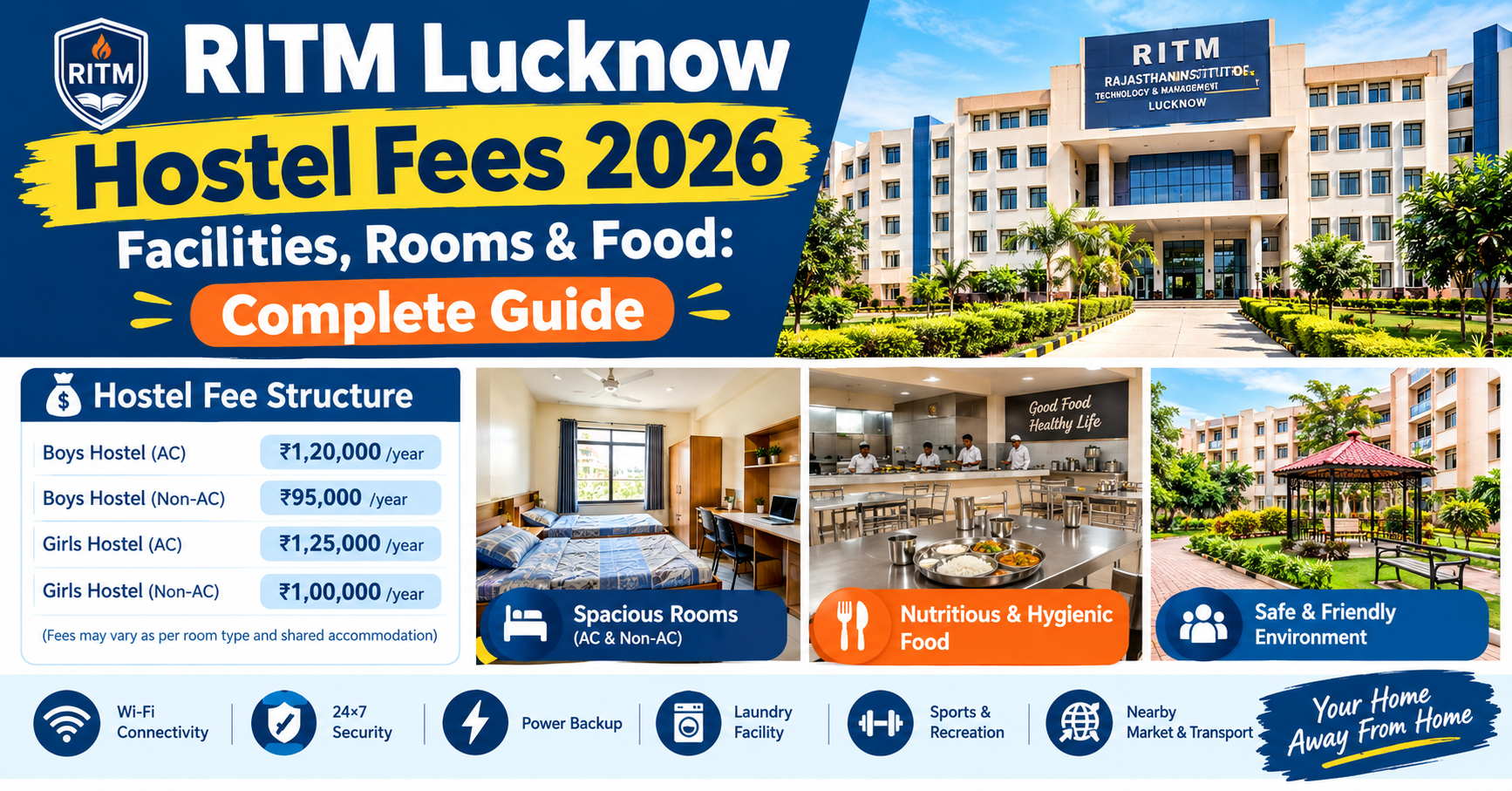
RITM Lucknow Hostel Fees, Facilities, Rooms & Food: Complete Guide
RITM Lucknow's hostel fees for 2026 range from roughly ₹45,000 to ₹60,000 per year, typically covering a shared room (2–3 students) and mess charges. Boys' and girls' hostels are separate blocks — the girls' hostel is generally inside the main campus, while the boys' hostel is located outside. Exact fees vary by room type, so confirm the final figure with the RITM admissions office before applying.
⚡ Quick Answer
RITM Lucknow hostel fees for 2026 range from roughly ₹45,000 to ₹60,000 per year, usually covering a shared room and mess charges. Boys' and girls' hostels are separate blocks, with rooms typically shared by 2–3 students. Exact fees vary by room type, so confirm the final figure with the admissions office before applying.
📌 Key Takeaways
- Annual hostel fee ranges from approximately ₹45,000 to ₹60,000, sometimes bundled with mess charges. Rooms are mostly shared (2–3 students) with basic furnishings like a bed, table, chair, and cupboard. Girls' hostel is generally inside the main campus; boys' hostel is typically located outside. Facilities include 24x7 security, power backup, Wi-Fi, laundry, and access to a campus health centre. Food quality reviews are mixed — some call it hygienic, others rate it below average. Hostel seats are limited and allotted at admission time, so apply early. RITM's hostel fees sit mid-range compared to government colleges and premium private universities in Lucknow.
Rameshwaram Institute of Technology and Management (RITM), Lucknow is one of the popular AKTU-affiliated private institutes on Sitapur Road, known for its B.Tech, MBA, BBA, and B.Pharma programs. For students coming from outside Lucknow, on-campus hostel accommodation is a major deciding factor while choosing this college. This guide covers everything you need to know about RITM Lucknow hostel fees 2026, room types, facilities, food quality, and how it compares with nearby options — so you can plan your budget and expectations before taking admission.
RITM Lucknow Hostel Fees 2026 (Overview)
The hostel fee at RITM Lucknow is charged annually and varies slightly depending on the room type, occupancy, and gender-specific block chosen. Based on official fee data and student reviews, the annual hostel fee ranges between approximately INR 24,000 and INR 60,000, with most students paying around INR 50,000 per year for a standard shared room including mess charges.
| Hostel Fee Component | Approximate Annual Cost (INR) |
|---|---|
| Boys Hostel (Shared Room) | 45,000 – 50,000 |
| Girls Hostel (Shared Room) | 45,000 – 50,000 |
| Hostel + Mess (Combined, Standard) | 50,000 – 60,000 |
| Budget/Basic Room Option | 24,000 – 35,000 |
| Security Deposit (Refundable, one-time) | 5,000 – 10,000 (approx., confirm with admission office) |
Hostel fees at RITM Lucknow range from about INR 24,000 to INR 50,000 per year, with rooms typically shared by 2 to 3 students. Independent comparisons of BTech colleges in Lucknow place RITM’s hostel-and-mess fees at up to around INR 60,000 per year, higher than some government colleges but well below premium private universities.
It’s worth noting that fee figures reported across portals differ slightly — some list a flat INR 50,000 per year for both male and female students, while others show a lower entry-level slab. This is common because hostel pricing often depends on room sharing (2-seater vs 3-seater), floor, and whether mess charges are bundled in. Always confirm the current, exact fee slab with the RITM admissions office before submitting your hostel application, since fee structures can be revised each academic year.
Year-on-Year Hostel Fee Comparison
| Year | Approximate Annual Hostel Fee (INR) | Notes |
|---|---|---|
| 2024 | 45,000 – 55,000 | Base mess charges included |
| 2025 | 48,000 – 58,000 | Minor revision, WiFi upgrade cited |
| 2026 | 50,000 – 60,000 | Current fee slab, confirm at admission |
Hostel Facilities at RITM Lucknow
RITM Lucknow provides separate hostel blocks for boys and girls, along with a set of standard amenities aimed at making campus life convenient for outstation students. According to the college’s own description and multiple student reviews, the hostels are positioned as “fully furnished modern hostels” with round-the-clock security.
The hostels are described as fully furnished, with rooms available separately for boys and girls within the campus, backed by 24×7 security, power backup, a café, roughly 10 Mbps Wi-Fi connectivity, and laundry service. The hostel infrastructure follows a parallel-row room arrangement and includes facilities like a large playground for outdoor activity.
| Facility | Details |
|---|---|
| Security | 24×7 guard presence, CCTV monitoring on most floors |
| Power Backup | Available for common areas and rooms |
| Wi-Fi | Basic connectivity provided (speed and reliability vary as per reviews) |
| Laundry | On-campus laundry service |
| Café/Canteen | Small in-hostel café in addition to the main campus cafeteria |
| Recreation | Large playground/open ground for sports and leisure |
| Medical Support | Access to the campus health centre for first aid and routine check-ups |
| Room Cleaning | Housekeeping support (frequency varies by block) |
The broader campus also supports hostel life indirectly. A full-fledged health centre is located on campus for immediate first aid and medical care, alongside technologically equipped classrooms, libraries, computer labs, gyms, cafeterias, and sports facilities. The college also runs its own medical office where a doctor organizes routine medical check-ups, pathology camps, yoga and fitness sessions, and blood donation camps.
However, prospective students should weigh this against real user feedback. Reviews are mixed — while some students describe the hostel infrastructure and Wi-Fi positively, others mention that promised Wi-Fi access hasn’t always been consistent and that hostel discipline and warden behaviour can feel strict. It’s a good idea to visit the hostel in person or speak to current residents before finalizing your decision.
Room Types and Occupancy
RITM Lucknow hostels typically offer shared rooms rather than single-occupancy options, which keeps costs lower but means less personal space. Based on available information:
| Room Type | Typical Occupancy | Furnishings Included |
|---|---|---|
| Standard Shared Room | 2–3 students | Bed, study table, chair, cupboard |
| Budget Room | 3–4 students | Bed, table, shared storage |
| (Single rooms) | Rarely available / limited | On request, subject to availability and extra cost |
Rooms typically accommodate 2 to 3 students and are equipped with beds, study tables, chairs, and cupboards. This setup is fairly standard for AKTU-affiliated private colleges in the Lucknow region, where most hostels prioritize functional, budget-friendly furnishing over premium single-occupancy setups.
Because seats are limited, hostel accommodation is generally allotted at the time of admission and is subject to vacancy. Students are advised to apply for a hostel seat as early as possible during the admission process rather than waiting until after classes begin, since demand often exceeds the number of available beds, especially for girls’ hostel rooms inside the main campus.
Boys Hostel vs Girls Hostel: Key Differences
One detail that matters a lot for admission planning is that boys’ and girls’ hostel accommodation at RITM is not always structured the same way.
| Aspect | Boys Hostel | Girls Hostel |
|---|---|---|
| Location | Reported to be located outside the main campus | Reported to be located inside the main campus |
| Annual Fee | ~45,000 – 50,000 | ~45,000 – 50,000 |
| Security | Standard hostel security | Higher supervision, inside campus perimeter |
| Curfew/Rules | Moderate | Comparatively stricter, as per some reviews |
According to student-shared details, the boys’ hostel is located outside the main campus while the girls’ hostel is inside the campus, with fees of around INR 50,000 per year; nearby PG accommodations tend to be cheaper. If campus location matters to you (for safety, convenience, or curfew reasons), it’s worth clarifying this directly with the admissions office, since arrangements can change between academic sessions.
Food and Mess Facilities
Food quality is one of the most talked-about — and most debated — aspects of RITM Lucknow’s hostel experience. Reviews are genuinely split, so it helps to look at both sides before forming an opinion.
Positive feedback: Some students and reviewers describe the food as hygienic and satisfactory, noting that the mess maintains reasonable cleanliness standards. Some reviews describe the food as very hygienic, with hostel rooms also kept clean and the overall campus infrastructure described positively. Other feedback specifically mentions that the quality of food is good for girls staying at the hostel.
Negative feedback: On the other hand, a meaningful number of reviews are critical. Mess food quality is reported to vary, with some students describing it as poor while others find it satisfactory. Some reviewers go further, noting that food is included in the hostel fee but describing it as below-par compared to other hostels in the area. A few especially critical reviews mention hygiene concerns around hostel food and warden conduct, though such extreme opinions are not universal.
| Food/Mess Aspect | What Reviews Say |
|---|---|
| Hygiene | Mixed — some call it hygienic, others disagree |
| Taste & Variety | Below average to average, per most reviews |
| Meal Timings | Fixed mess timings (breakfast, lunch, dinner) |
| Cost | Usually bundled into the combined hostel + mess fee |
| Special/Festive Meals | Occasionally arranged during festivals, per some reviews |
Practical takeaway: Given the mixed reviews, it’s sensible to sample the mess food (if possible, during a campus visit) or talk to current hostel residents before committing. Some students who found the mess food unsatisfactory have opted for nearby PG accommodations or private tiffin services as a workaround, though this adds to overall costs.
How RITM Lucknow Hostel Fees Compare to Other Lucknow Colleges
To help you evaluate whether RITM’s hostel fees are reasonable, here’s how it stacks up against other engineering colleges in Lucknow:
| College | Approx. Annual Hostel + Mess Fee (INR) | Type |
|---|---|---|
| IET Lucknow | 14,500+ | Government |
| RITM Lucknow | 45,000 – 60,000 | Private |
| IIIT Lucknow | ~80,000 (per year, based on ~40,000/semester) | Institute of National Importance |
| Amity University Lucknow | 1,20,000+ | Private (Premium) |
Hostel and mess fees across Lucknow colleges range from around ₹14,500 per year at IET to about ₹60,000 per year at RITM, and go beyond ₹1,20,000 per year at premium private universities like Amity. This places RITM in the mid-range bracket — pricier than government colleges but noticeably more affordable than premium private universities in the city.
Total Cost Perspective: Tuition + Hostel
Since hostel costs don’t exist in isolation, here’s a rough combined picture for B.Tech students:
| Cost Head | Approximate Annual Figure (INR) |
|---|---|
| B.Tech Tuition Fee (1st year) | ~74,250 |
| Hostel + Mess Fee | 45,000 – 60,000 |
| Estimated Total (per year, hostel students) | 1,20,000 – 1,35,000 approx. |
RITM’s B.Tech fee is reported at INR 74,250 for the first year, while the MBA fee stands at around INR 70,000 for the first year. Combined with hostel charges, outstation students should budget roughly this range annually, though scholarship support (discussed below) can bring the effective cost down.
Scholarships That Can Offset Hostel Costs
While scholarships typically apply to tuition rather than hostel fees directly, they still ease the overall financial burden for hostel residents. RITM Lucknow offers a variety of scholarships for meritorious students to help reduce the overall cost of education, and the college along with the state government provides multiple financial aid options. Many students specifically mention benefiting from UP government scholarship schemes, which can substantially lower net education costs even while living in a paid hostel.
Should You Choose RITM Lucknow Hostel or a Private PG?
This is a common dilemma for incoming students. Here’s a quick comparison to help decide:
| Factor | RITM Hostel | Private PG/Rental Nearby |
|---|---|---|
| Cost | Fixed annual fee (~45,000–60,000) | Often cheaper, but varies by location |
| Convenience | On/near campus, no commute | May require transport arrangements |
| Food | Mixed reviews, mess-style | Self-managed or PG-provided, more control |
| Security | Structured (guards, CCTV) | Depends on the property |
| Independence | Limited (hostel rules, curfew) | Generally more flexible |
External rental options and PG accommodations are available near the campus, often at lower costs than the hostel. If mess food quality or hostel rules are a major concern for you, a nearby PG can be a reasonable alternative — though it requires more independent planning around meals and daily commuting.
How to Apply for RITM Lucknow Hostel Accommodation
Since hostel seats are limited, it helps to know the process in advance rather than scrambling for a room after classes start.
- Apply during admission: Hostel accommodation requests are usually made alongside the main admission form, not as a separate later process.
- Choose your preference: Indicate whether you want the boys’ or girls’ block and, if options exist, your preferred room-sharing type (2-seater or 3-seater).
- Pay the fee and deposit: Hostel fees (and any refundable security deposit) are typically paid along with or shortly after tuition fee payment, through the modes accepted by the college’s accounts office.
- Confirm allotment: Since rooms are subject to vacancy, get written or official confirmation of your room allotment before assuming a seat is guaranteed.
- Carry required documents: Keep ID proof, admission confirmation, and fee receipts handy when reporting to the hostel warden on move-in day.
If you’re unable to secure a hostel seat, or prefer more independence, the area around RITM’s Sitapur Road campus does have private PG and rental options, generally at a lower cost than the hostel — though these come without the built-in security and structure of on-campus living.
Final Thoughts
RITM Lucknow’s hostel setup offers a reasonably affordable, mid-range option for outstation students, with basic but functional facilities like 24×7 security, power backup, Wi-Fi, and a dedicated health centre. The biggest variable to watch is food quality, where reviews genuinely differ — so it’s worth doing your own due diligence, whether that means visiting the mess in person, talking to current hostel residents, or checking the latest reviews closer to your admission date. Since exact fee slabs and room availability can shift each academic year, always cross-verify the final 2026 hostel fee structure directly with the RITM admissions office before making your accommodation decision.
Helpful answers
Frequently asked questions
What is the hostel fee at RITM Lucknow for 2026?
Approximately ₹45,000 to ₹60,000 per year, with some sources citing a flat ₹50,000 rate for both male and female students, usually inclusive of mess charges.
Are RITM Lucknow hostel rooms shared or single?
Mostly shared — 2 to 3 students per room — furnished with a bed, study table, chair, and cupboard. Single rooms are rarely available.
Is the hostel food good at RITM Lucknow?
Reviews are mixed; some students describe it as hygienic and satisfactory, others rate it below average. It's worth checking recent reviews or visiting before deciding.
Is the girls' hostel inside the campus?
Based on available student feedback, the girls' hostel is generally located inside the main campus, while the boys' hostel is outside.
Does RITM Lucknow offer scholarships that help with hostel costs?
Scholarships mainly reduce tuition fees rather than hostel charges directly, but they lower the overall cost of studying and living at RITM.
How does RITM's hostel fee compare to other Lucknow colleges?
It's mid-range — higher than government colleges like IET Lucknow, but well below premium private universities such as Amity.
Reader feedback