
Study in Australia for International Students: The Complete 2026-27 Guide
To study in Australia as an international student, you need an offer from a CRICOS-registered provider and a Subclass 500 student visa (AUD 2,500 fee from 1 July 2026). You must show AUD 29,710 in living costs plus tuition, meet the Genuine Student requirement, and hold IELTS 6.0 or equivalent and OSHC health cover. Budget roughly AUD 55,000 to 75,000 for the first year, and confirm current fees on the Home Affairs website before you apply.
⚡ Quick Answer
To study in Australia as an international student, you need a Confirmation of Enrolment from a CRICOS-registered provider and a Subclass 500 student visa (AUD 2,500 fee from 1 July 2026). You must pass the Genuine Student requirement and show AUD 29,710 for living costs plus tuition and airfare. You also need IELTS 6.0 or equivalent and OSHC cover. You can work 48 hours per fortnight during term.
📌 Key Takeaways
- The Subclass 500 visa fee is AUD 2,500 from 1 July 2026, up from AUD 2,000. You must show AUD 29,710 in living costs, plus first-year tuition and return airfare. The Genuine Student requirement replaced the GTE test in March 2024. Template answers are a common cause of refusal. The primary student visa refusal rate reached a reported 24.2% in the year to June 2026, a ten-year high. The 2027 National Planning Level stays at 295,000. It prioritises visa processing and is not a hard cap. Nine Australian universities are in the QS 2027 top 100. UNSW Sydney (19th) is now first nationally. Student visa holders can work 48 hours per fortnight in term and unlimited hours in scheduled breaks. Part-time wages will not cover tuition. Budget about AUD 55,000 to 75,000 for year one. The Temporary Graduate visa (485) runs up to 2 or 3 years. Most applicants must be under 35. Verify all fees and thresholds on the Home Affairs website before lodging.
Study in Australia for international students is still one of the strongest study-abroad options in the world: nine universities in the global top 100, a post-study work visa, and legal part-time work. It is also harder and more expensive than it was three years ago. Visa fees have risen, refusal rates are at a ten-year high, and the government now manages how many new students can enter.
This guide covers what matters: costs, visa requirements, universities, cities, work rights, scholarships, post-study options, and the mistakes that get applications refused. Where the picture is unflattering, it says so.
Study in Australia at a Glance (2026-27)
| Item | Current position |
|---|---|
| Student visa | Subclass 500 |
| Visa application fee | AUD 2,500 (from 1 July 2026; was AUD 2,000, before that AUD 1,600) |
| Living-cost proof (single student, 12 months) | AUD 29,710 |
| Minimum English (most degrees) | IELTS 6.0 overall, no band below 5.5 (or equivalent) |
| Work limit during term | 48 hours per fortnight; unlimited in scheduled breaks |
| Health cover | OSHC mandatory for the whole stay |
| National Planning Level, 2027 | 295,000 new overseas student commencements |
| Post-study work visa | Subclass 485, 2 to 3 years depending on degree; under-35 age limit for most applicants |
| Top-ranked Australian university (QS 2027) | UNSW Sydney, 19th globally |
Why Study in Australia for International Students
Globally Ranked Universities
In the QS World University Rankings 2027, published in June 2026, nine Australian universities placed in the top 100. UNSW Sydney became the country’s top-ranked university for the first time, overtaking the University of Melbourne. Six Group of Eight universities sit in the global top 40, and all eight are inside the top 80.
Rankings are a blunt tool. They reflect research output and reputation more than teaching quality in your specific course. Use them to filter, not to decide.
Work Rights During Study
Student visa holders can work up to 48 hours per fortnight while their course is in session and unlimited hours in official breaks. Masters by research and PhD students are exempt from the hourly cap once the course begins. Australian minimum wage applies to international students on the same basis as citizens.
A Defined Post-Study Pathway
Graduates of bachelor, masters, and doctoral degrees can apply for the Temporary Graduate visa (subclass 485) to live and work in Australia after finishing. It is not permanent residency, and it has become more restrictive, but it remains a real route to work experience and, for some, skilled migration.
Multicultural, English-Speaking Environment
Australian campuses are among the most internationally diverse anywhere. Instruction is in English, student services are established, and the legal framework (the ESOS Act) gives international students enforceable rights against providers.
The Reality Check: What Has Changed Since 2023
Any honest guide to studying in Australia as an international student has to start here. Most older blog posts are out of date.
Managed Growth and the National Planning Level
The government sets an annual National Planning Level (NPL) for new international students. For 2027 it stays at 295,000, the same as 2026. Of that, 161,725 places go to public universities and 38,500 to other higher education providers, with the rest covering the vocational sector.
Important points:
- The NPL is a prioritisation system, not a hard cap. Any genuine student who meets visa requirements can still apply.
- Commencements in 2026 are tracking about 8% below the same period in 2025 and 13% below 2019, so the planning level is not currently the binding constraint.
- No provider receives a lower allocation in 2027 than in 2026. TAFE students are exempt from the NPL in 2027. Schools, standalone English courses, higher degree research, and exchange students are also exempt.
- From 2027 the Australian Tertiary Education Commission oversees allocations for higher education providers.
Ministerial Direction 115: Who Gets Processed First
Since 14 November 2025, offshore student visa applications have been sorted into three priority levels under Ministerial Direction 115, which replaced Direction 111. Providers that manage their allocation responsibly receive faster processing; providers that exceed their allocation by about 15% drop in priority. It applies to applications lodged outside Australia.
What it means for you: your choice of provider can affect how long your visa takes. Ask the institution which priority status it holds.
Refusal Rates Are at a Decade High
Reported Home Affairs data shows the primary student visa refusal rate reached 24.2% in the year to June 2026, the highest in ten years. Refusal rates vary sharply by nationality: reports cite more than 51% for Nepal and more than 40% for India across 2025-26. February 2026 recorded the lowest monthly grant rate in over two decades of tracking, at 67.6%.
Translation: an offer letter does not equal a visa. Weak documentation, unclear study reasons, or a mismatch between your background and your course will sink an application.
Fees Keep Rising
| Fee | Before | Now |
|---|---|---|
| Student visa (subclass 500), main applicant | AUD 1,600 | AUD 2,500 (from 1 July 2026) |
| Additional applicant aged 18+ | AUD 1,225 (July 2025) | Check Home Affairs; concessional amounts reported from AUD 745 to AUD 2,050 |
| Temporary Graduate visa (subclass 485) | About AUD 2,300 | Reported AUD 4,600 from 1 March 2026 and AUD 5,750 from 1 July 2026 |
Visa application charges are not refunded if you are refused.
Best Universities for International Students in Australia
QS World University Rankings 2027: Australian Top 12
| National rank | University | Global rank | City |
|---|---|---|---|
| 1 | UNSW Sydney | 19 | Sydney |
| 2 | University of Melbourne | 22 | Melbourne |
| 3 | University of Sydney | 28 | Sydney |
| 4 | Australian National University | 29 | Canberra |
| 5 | Monash University | 31 | Melbourne |
| 6 | University of Queensland | 40 | Brisbane |
| 7 | University of Western Australia | 77 | Perth |
| 8 | Adelaide University | 79 | Adelaide |
| 9 | University of Technology Sydney | 87 | Sydney |
| 10 | RMIT University | 119 | Melbourne |
| 11 | Macquarie University | 126 | Sydney |
| 12 | Curtin University | 189 | Perth |
Group of Eight vs Everyone Else
The Group of Eight (Go8) are the research-intensive universities: Melbourne, Sydney, ANU, UNSW, Queensland, Monash, UWA, and Adelaide. They carry the strongest global brand and the highest entry requirements and tuition fees.
The next tier, including UTS, RMIT, Macquarie, Curtin, Deakin, Griffith, QUT, and Wollongong, often matches the Go8 on employability in specific fields and can cost less. For engineering, IT, nursing, and business, course accreditation and industry placements matter more than overall rank.
How to Choose a University: Practical Criteria
| Criterion | What to check |
|---|---|
| Registration | Course and provider on the CRICOS register. Without CRICOS, you cannot get a student visa |
| Accreditation | Professional bodies for your field: Engineers Australia, nursing boards, accounting bodies |
| Visa priority status | Whether the provider is under or over its allocation under MD115 |
| Graduate outcomes | Employment and salary data for your specific course, not the university average |
| Location | Regional campuses can improve second post-study visa eligibility |
| Total cost | Tuition plus city living costs, not tuition alone |
Study Levels and Pathways
| Level | Typical length | Typical entry | Notes |
|---|---|---|---|
| English (ELICOS) | 5 to 48 weeks | Varies | Packaged courses allow lower visa English scores |
| Foundation / Diploma | 6 to 12 months (Foundation); 1 to 2 years (Diploma) | Year 11/12 or equivalent | Pathway into year 1 or 2 of a bachelor |
| Vocational (VET / TAFE) | 6 months to 2 years | Varies | Cheaper, trade-focused, linked to the Post-Vocational Education Work stream |
| Bachelor | 3 to 4 years | Year 12 or equivalent plus English | Honours adds a year |
| Masters (coursework) | 1 to 2 years | Bachelor degree | Most popular route for international postgraduates |
| Masters (research) / PhD | 2 / 3 to 4 years | Strong academic record, supervisor | No work-hour cap; 485 stay up to 3 years |
Best Cities to Study in Australia
| City | Strengths | Trade-offs |
|---|---|---|
| Sydney | Largest job market, finance, tech, UNSW, Sydney, UTS, Macquarie | Highest rent in the country |
| Melbourne | Student-focused culture, arts, Melbourne, Monash, RMIT | Rent rising; weather swings |
| Brisbane | Lower cost than Sydney/Melbourne, University of Queensland, growing job market | Fewer corporate head offices |
| Canberra | ANU, government and policy careers, quiet, safe | Small city, limited nightlife |
| Perth | UWA, Curtin; mining and engineering; regional extension eligibility for graduates | Isolated from eastern cities |
| Adelaide | Lower living costs, Adelaide University; regional extension eligibility | Smaller graduate job market |
Reported 485 rules give an extra year for graduates who studied and lived in Category 2 areas (such as Perth, Adelaide, Canberra, Gold Coast) and two extra years for Category 3 areas (other regional locations). Verify current eligibility before choosing a campus on this basis; it is a policy lever the government has been tightening.
Student Visa (Subclass 500): Requirements Explained
Core Requirements
| Requirement | What you must show |
|---|---|
| Confirmation of Enrolment (CoE) | Offer accepted and tuition deposit paid to a CRICOS-registered course |
| Genuine Student (GS) requirement | Written responses showing you intend to study, not use the visa as a work or migration shortcut |
| Financial capacity | Funds for tuition, living costs, and travel |
| English proficiency | Approved test score (or exemption) |
| OSHC | Health cover for the entire visa period |
| Health and character | Medicals and police certificates where requested |
| Australian values statement | Signed as part of the application |
The Genuine Student Requirement
The GS requirement replaced the Genuine Temporary Entrant (GTE) test on 23 March 2024. It is the main reason strong-on-paper applicants fail. Decision-makers read your answers against your history. They look at:
- Why this course, why Australia, why this provider, instead of studying in your home country
- How the course fits your previous study and work
- Your ties and circumstances at home, and the likely benefit of the qualification
- Whether your finances and your story are consistent
Generic answers copied from templates are a known refusal pattern. Write specific, verifiable reasons. A career gap, a switch of field, or a course far below your existing qualification needs an explicit explanation.
Financial Capacity
| Item | Amount (AUD) |
|---|---|
| Living costs, main applicant, 12 months | 29,710 |
| Partner (reported figure) | About 10,394 |
| Each dependent child (reported figure) | About 4,449 |
| School costs per school-aged child (reported figure) | About 13,502 per year |
| Tuition | First 12 months of fees (or full course if under 12 months) |
| Travel | Return airfare |
The living-cost figure of AUD 29,710 is the one repeated across 2026 sources. Partner and child amounts come from migration-agent summaries, so check the official Home Affairs page.
Funds must be genuine and traceable. Large, recent, unexplained deposits are a red flag. Sudden transfers shortly before lodgement can trigger further requests for information.
English Language Requirements
| Study type | Minimum IELTS (overall) | PTE Academic |
|---|---|---|
| Higher education (bachelor, masters) | 6.0 (no band below 5.5) | 50 |
| Packaged with ELICOS | 5.0 (as reported by IDP) | Check Home Affairs |
| Foundation / pathway | 5.5 (as reported by IDP) | Check Home Affairs |
Other accepted tests include TOEFL iBT, Cambridge C1 Advanced, OET, CELPIP, and LanguageCert Academic. Results generally need to be no more than two years old at application. Your university may require a higher score than the visa does; the higher number governs.
Overseas Student Health Cover (OSHC)
OSHC is compulsory and must cover your full stay. A single student typically pays roughly AUD 500 to 800 per year, depending on provider and level of cover. Couples and families pay several times more. Prices are reviewed annually, so get a live quote.
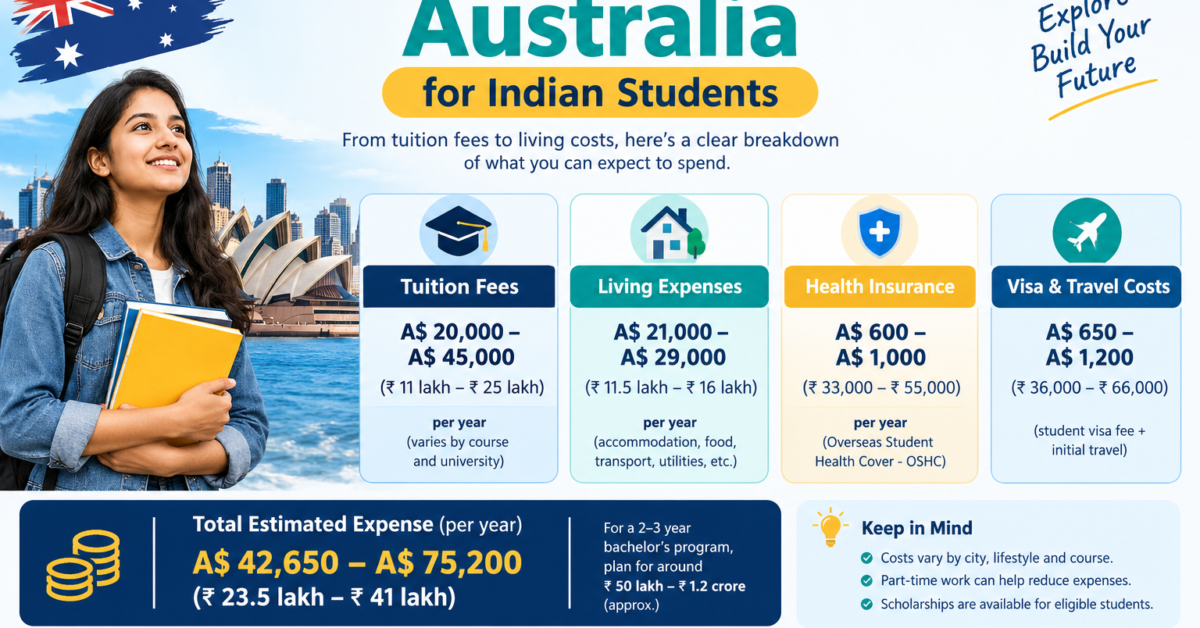
How Much Does It Cost to Study in Australia?
Tuition Fees by Level (Indicative)
| Level | Approximate annual tuition (AUD) |
|---|---|
| Bachelor | 22,000 to 45,000 |
| Masters (coursework) | 25,000 to 50,000 (varies strongly by field) |
| Vocational / diploma | 10,000 to 25,000 |
| Medicine, dentistry, veterinary science | Substantially higher than the above |
Most 2026 sources place bachelor fees between AUD 22,000 and AUD 45,000 per year. Masters and professional-course ranges above are indicative estimates; the only reliable number is the one on your offer letter. Engineering, medicine, and some business degrees sit at the top. Humanities and education sit at the bottom.
Living Costs
The visa threshold of AUD 29,710 is a proof-of-funds number, not a budget. Realistic spend depends on the city and your housing choice. One 2026 Sydney estimate puts monthly living costs before tuition at AUD 1,400 to 2,100.
| Expense | Typical monthly range (AUD, indicative) |
|---|---|
| Rent (shared room) | 800 to 1,500 depending on city |
| Food and groceries | 350 to 600 |
| Transport | 100 to 250 |
| Phone, internet, utilities | 80 to 200 |
| Study materials, personal | 100 to 250 |
These ranges are planning estimates, not official figures. Sydney and Melbourne sit at the high end of rent; Adelaide, Perth, and Brisbane are generally lower.
Sample First-Year Cash Requirement
| Item | Example (AUD) |
|---|---|
| Tuition (example 12-month bachelor fee) | 30,000 |
| Living-cost proof | 29,710 |
| Student visa fee | 2,500 |
| OSHC (single, one year) | About 700 |
| Return airfare | About 1,500 |
| Medicals, English test, documents | About 800 |
| Total to arrange | About 65,000 |
This is an illustration using a mid-range tuition fee. Your number will differ.
Do Not Rely on Part-Time Work to Pay Tuition
At 48 hours per fortnight, you earn enough to offset part of your living costs, not tuition. Anyone planning to fund fees from wages is building a plan that fails. Casual shifts are also unpredictable and are not accepted as evidence of funds for the visa.
Working While Studying
The Rules
| Rule | Detail |
|---|---|
| Work cap during term | 48 hours per fortnight, counted over any 14-day period starting Monday |
| Breaks | Unlimited hours in official course breaks |
| Research students | Masters by research and PhD students exempt once the course starts |
| Mandatory work placements | Not counted if they are a required part of a CRICOS-registered course |
| Multiple jobs | Combined hours must stay under the cap |
| Start date | Not before your course begins |
You cannot average hours: 40 in week one and 8 in week two is acceptable only because the 14-day total is 48. Exceed it and you risk breaching visa condition 8105, which can lead to cancellation.
Some 2025-26 articles mention a proposal to lift the cap to 60 hours per fortnight from 1 July 2026. Sources published after that date still state 48, so plan on 48 unless Home Affairs confirms otherwise.
Tax and Super
Get a Tax File Number from the Australian Taxation Office before you start. Employers pay superannuation on top of your wages. When you leave Australia permanently, you can claim it back through the Departing Australia Superannuation Payment (DASP), subject to tax.
Scholarships and Funding
| Type | Examples | Notes |
|---|---|---|
| Government | Australia Awards, Destination Australia (regional) | Competitive; criteria and eligible countries vary by round |
| University merit | Tuition reductions at many institutions | Commonly reported waiver range of 15% to 50% |
| Research | Research stipends and tuition support for higher degree research | Often tied to supervisor and project funding |
| External | Home-country government and employer schemes | Check deadlines early |
How to approach scholarships: apply with your admission application, not after. Many university awards are assessed automatically at offer stage. Treat any agent promising guaranteed scholarship amounts as a warning sign.
Intakes and Application Timeline
Most universities admit students in February/March (Semester 1) and July (Semester 2). Some offer November or trimester starts. Semester 1 is the largest intake with the widest course availability.
| Timing before course start | Task |
|---|---|
| 12 to 9 months | Research courses and providers, book English test, check CRICOS registration |
| 9 to 6 months | Submit applications, begin scholarship applications |
| 6 to 4 months | Receive offers, accept, pay deposit, receive CoE |
| 4 to 3 months | Buy OSHC, prepare financial evidence, draft GS responses, lodge visa |
| 3 to 1 month | Visa grant (processing varies; allow more time under tighter checks), arrange housing and flights |
| 1 month | Book airport pickup, set up bank and phone, attend orientation |
Processing times in 2026 vary by provider priority and applicant profile. Careers360 cites an average of 4 to 8 weeks, but anything that triggers integrity checks takes longer. Lodge early.
After Graduation: Post-Study Work and Permanent Residency
Temporary Graduate Visa (Subclass 485)
| Qualification | Stay period | Age limit |
|---|---|---|
| Bachelor | Up to 2 years | Under 35 |
| Masters (coursework) | Up to 2 years | Under 35 |
| Masters (research) | Up to 3 years | Under 50 |
| Doctorate (PhD) | Up to 3 years | Under 50 |
| Hong Kong / BNO passport holders | Up to 5 years | Under 50 |
| Vocational graduates (Post-Vocational Education Work stream) | About 18 months | Under 35; skills assessment required |
Other key points:
- Reported English requirement is IELTS 6.5 overall, higher than for the student visa.
- You generally have to apply within six months of completing your course. Late lodgement means refusal.
- Graduate certificates now face stricter eligibility rules.
- The general extension for selected degrees has been scrapped. The remaining extension is the regional second 485.
- Fees have climbed steeply: reported AUD 5,750 from 1 July 2026.
The policy direction is clear: the 485 is being repositioned as an early-career bridge, not a long-term holding status. A graduate who plans to stay for years must plan the migration pathway while still studying.
Permanent Residency: Realistic Expectations
The 485 is not a guarantee of PR. Skilled pathways include subclass 189 (independent), 190 (state-nominated), and 491 (regional). They rely on a points test with a pass mark of 65, occupation demand, English scores, and age. Points drop sharply after 33 and are zero at 45.
Practical advice:
- Choose a course tied to an occupation in genuine demand (engineering, nursing, teaching, IT, trades), not a course chosen only for visa reasons.
- Check the skilled occupation lists before enrolling. They change.
- Do not pay anyone for a guaranteed PR outcome. No one can promise it.
Common Mistakes That Lead to Refusal or Regret
| Mistake | Why it hurts | Fix |
|---|---|---|
| Template GS answers | Reads as scripted; decision-makers look for specifics | Write your own, tied to your history and goals |
| Unexplained funds | Raises integrity concerns | Show source, history, and sponsor evidence |
| Course mismatch | Cert IV after a master’s, or an unrelated field, without a reason | Show a logical progression or explain the pivot |
| Choosing the cheapest provider | Weaker support, higher risk, possible low visa priority | Check provider quality and MD115 status |
| Relying on an agent’s guarantee | No agent controls visa decisions | Use registered agents; keep copies of everything |
| Ignoring the 485 age limit | Locked out at 35 | Plan graduation date against your birthday |
| Exceeding work hours | Visa cancellation risk | Track hours across 14-day periods |
| Skipping OSHC | Visa condition breach | Buy it for the full visa period |
Step-by-Step Plan to Study in Australia
- Define the outcome. Pick the career or occupation first, then the course. Decide whether PR is a real goal or a hope.
- Shortlist 4 to 6 providers. Confirm CRICOS registration, accreditation, and total cost. Include at least one regional option.
- Take your English test early. Aim above the minimum; many universities ask for more than the visa does.
- Apply and compare offers. Apply for scholarships alongside admission.
- Accept and pay the deposit. Get your CoE.
- Buy OSHC and assemble finance evidence. Keep bank records clean and explainable.
- Write the Genuine Student responses. Specific, honest, consistent with your documents.
- Lodge online through ImmiAccount. Pay the AUD 2,500 charge. Respond to any information request quickly.
- Arrange accommodation and travel after grant. Do not book non-refundable flights before the visa is approved.
- Arrive, enrol, get a TFN, and track your work hours.
Conclusion
Study in Australia for international students remains a solid option for students with a clear plan, adequate funding, and a course that makes career sense. It is a poor option for anyone counting on part-time wages to pay tuition, anyone buying a course to chase PR, or anyone submitting a generic visa application.
The winning approach is simple: pick the career first, choose a credible provider, document your finances cleanly, write specific Genuine Student answers, and verify every fee and rule against Home Affairs before you lodge.
Sources and Verification Notes
- Study Australia (Australian Government): 2027 National Planning Level announcement, July 2026
- Department of Education: Managed growth for international education, indicative 2027 allocations
- Department of Home Affairs: student visa processing priorities and Ministerial Direction 115
- QS World University Rankings 2027 (published 18 June 2026), as reported by Time Out, CityNews, and PickMyUni
- Migration agency and lawyer summaries (One Planet Migration Law, MyVisa, The Migration, Roam Migration Law) for 2026 financial capacity, 485 rules, and fees
- Refusal-rate figures reported from Home Affairs data via ABC and secondary summaries
Several secondary sources conflict on specific amounts (for example 485 fees and English score thresholds for packaged courses). Figures flagged as reported should be checked on the official Home Affairs website before you rely on them.
Helpful answers
Frequently asked questions
How much does it cost to study in Australia for international students?
Plan for roughly AUD 55,000 to 75,000 in the first year. That covers tuition, the AUD 2,500 visa fee, OSHC health cover, airfare and the AUD 29,710 living-cost proof. Bachelor tuition is typically AUD 22,000 to 45,000 per year. Your offer letter gives the exact fee.
What is the student visa fee for Australia in 2026?
The Subclass 500 student visa application charge is AUD 2,500 for the main applicant from 1 July 2026. It was AUD 2,000 from July 2025. The fee is not refunded if the application is refused. Confirm the current amount on the Department of Home Affairs website before paying.
How much money do I need to show for an Australian student visa?
A single student must show AUD 29,710 for 12 months of living costs. You must also show your first year of tuition and return airfare. Partners and children add to the requirement. The funds must be genuine and traceable, because unexplained deposits can trigger refusal.
What English score do I need to study in Australia?
Most degree courses need IELTS 6.0 overall with no band below 5.5, or an equivalent such as PTE Academic 50. Packaged English and foundation courses can have lower visa thresholds. Your university may ask for a higher score than the visa does, and the higher requirement applies.
How many hours can international students work in Australia?
Student visa holders can work up to 48 hours per fortnight while their course is in session. They can work unlimited hours during scheduled course breaks. Masters by research and PhD students have no hourly cap once the course starts. Exceeding the limit can put your visa at risk.
What is the Genuine Student requirement?
The Genuine Student (GS) requirement replaced the Genuine Temporary Entrant test in March 2024. You must explain why you chose this course, provider and country, and how the course fits your study and work history. Generic or copied answers are a common cause of refusal, so write specific, honest responses.
Is Overseas Student Health Cover (OSHC) compulsory?
Yes. You must hold OSHC for the whole length of your student visa. A single student typically pays about AUD 500 to 800 per year, depending on the provider and level of cover. Prices change annually, so get a current quote.
How long does Australian student visa processing take?
Some sources report an average of 4 to 8 weeks, but times vary. Under Ministerial Direction 115, processing priority depends partly on how your provider manages its allocation. Applications with integrity concerns, such as unclear funds or weak Genuine Student answers, take longer. Lodge several months before your course starts.
What are the main intakes for Australian universities?
Most universities admit students in February or March (Semester 1) and July (Semester 2). Some also offer November or trimester starts. Semester 1 is usually the largest intake, with the widest range of courses.
Can I stay and work in Australia after graduating?
Eligible graduates can apply for the Temporary Graduate visa (subclass 485). It lasts up to 2 years for bachelor and coursework masters degrees and up to 3 years for research masters and PhDs. Most applicants must be under 35. It does not guarantee permanent residency.
Which Australian universities rank highest for international students?
In the QS World University Rankings 2027, the top Australian universities are UNSW Sydney (19th), University of Melbourne (22nd), University of Sydney (28th), ANU (29th), Monash (31st) and University of Queensland (40th). Nine Australian universities are in the global top 100. Choose by course quality, accreditation and total cost, not rank alone.
Are scholarships available for international students in Australia?
Yes. Options include Australia Awards, Destination Australia, university merit scholarships and research funding for higher degree students. University tuition reductions are commonly reported in the 15% to 50% range. Apply alongside your admission application, because many awards are assessed at offer stage.