Total Expense to Study in Australia for Indian Students
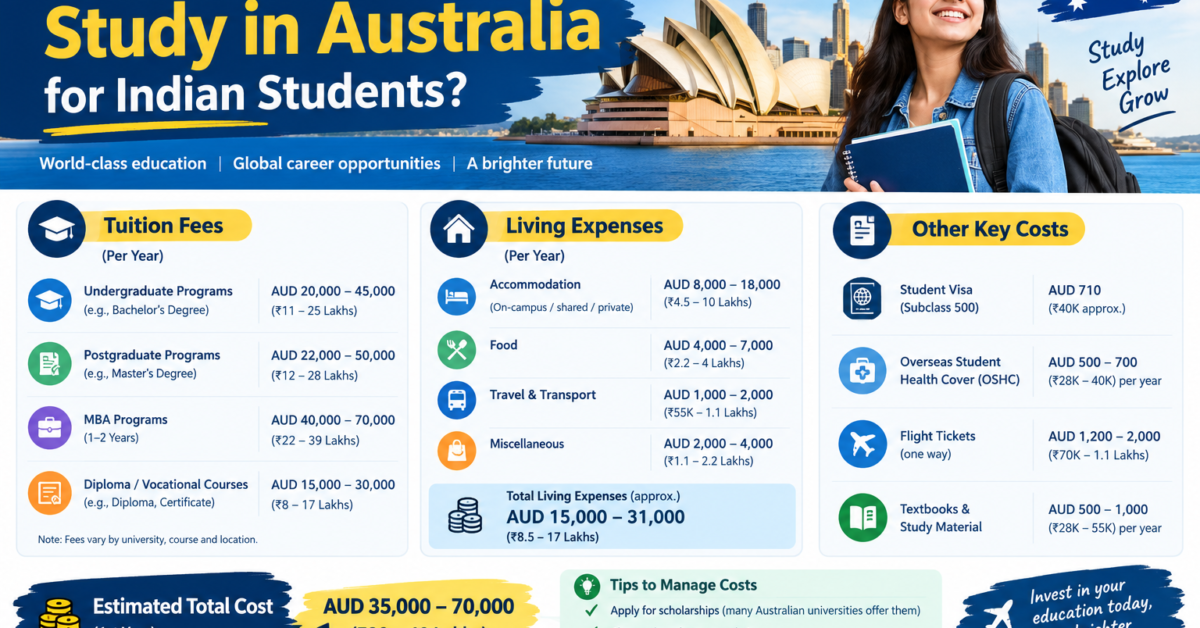
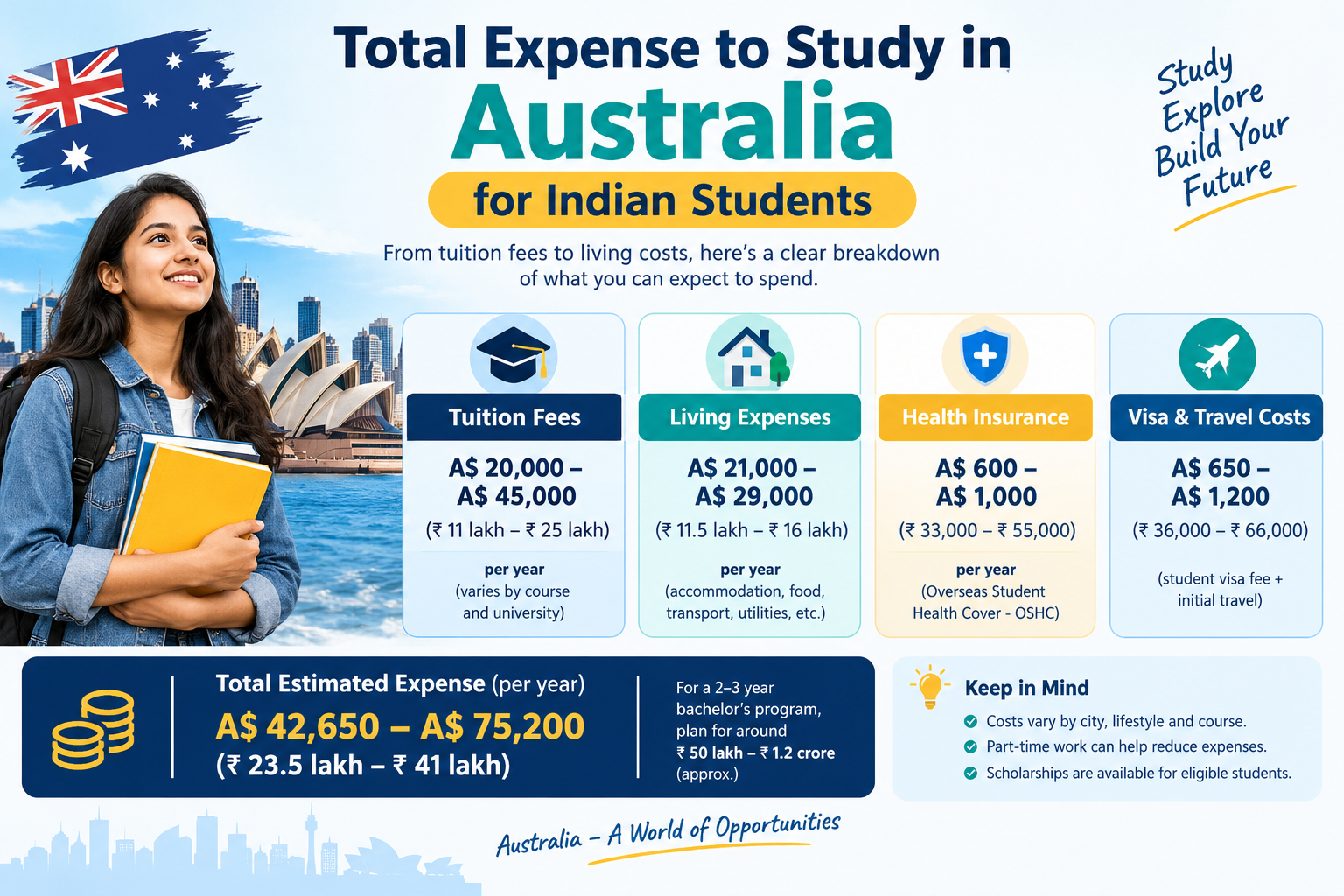
Studying in Australia costs Indian students about ₹36–55 lakh per year (AUD 54,000–82,000), and ₹75 lakh to ₹1.3 crore for a full degree. This covers tuition, rent, food, health cover and fees, at ₹67 per AUD.
⚡ Quick Answer
Studying in Australia costs Indian students about ₹36–55 lakh per year (AUD 54,000–82,000) including tuition, rent, food and health cover. A full degree costs ₹75 lakh to ₹1.3 crore. Tuition is AUD 25,000–50,000 per year, living costs are AUD 1,800–3,200 per month, and the student visa fee is AUD 2,500 (₹1.68 lakh). Figures use ₹67 per AUD.
📌 Key Takeaways
- Total cost is ₹36–55 lakh per year, or ₹75 lakh to ₹1.3 crore for a full degree. Tuition is AUD 25,000–50,000 per year for most bachelor’s and master’s courses. Living costs run AUD 1,800–3,200 per month, with Sydney and Melbourne at the top. The student visa fee rose from AUD 2,000 to AUD 2,500 on 1 July 2026. You must show AUD 29,710 (about ₹19.9 lakh) for 12 months of living costs. That is a minimum, not a comfortable budget for Sydney. One-time costs before classes start are about ₹3.8–5 lakh. Remittances above ₹10 lakh per year attract 2% TCS if self-funded. Loan-funded remittances attract none. Part-time work (48 hours per fortnight in term) offsets living costs, not tuition. Add a 10–15% buffer for rent rises, tuition increases and exchange-rate swings.
Studying in Australia as an Indian student costs roughly ₹36–55 lakh per year all-in (tuition, rent, food, health cover, everything). A full degree lands between ₹75 lakh and ₹1.3 crore depending on course length, university tier and city.
The three numbers that drive almost everything:
- Tuition: AUD 25,000–50,000 per year for most bachelor’s and master’s courses. Medicine, dentistry, MBA and some Group of Eight postgraduate degrees run far higher.
- Living costs: AUD 1,800–3,200 per month depending on city and housing. The visa authority assumes AUD 29,710 per year (₹19.9 lakh) as the minimum.
- One-time costs: about ₹3.8–5 lakh before you even start classes. The student visa alone is now AUD 2,500 (₹1.68 lakh).
If a consultant quotes you ₹20–25 lakh per year “all included” for a Sydney or Melbourne university, the quote is either wrong, leaves out rent, or refers to a cheap regional campus or vocational course. Verify before paying anything.
How these numbers were built
Published estimates for Australian costs disagree with each other by 20–30%. University websites, education agents and migration blogs use different assumptions about housing, city and course type. For this guide:
- Tuition ranges come from university and education-provider data for 2026, cross-checked across several sources, and I used the middle of the overlapping range.
- The visa fee, living-cost requirement, tax rule on remittances and work-hour rule were checked against current 2026 information.
- City-level living budgets are planning estimates built from typical shared-housing rents, groceries and transport. They are consistent with the commonly cited AUD 1,800–3,200 monthly range but are not official figures. Check live rent listings in your target suburb before committing.
- Tuition is quoted for full-time study. Part-time or reduced-load enrolment changes the per-semester numbers.
Treat everything below as a planning range, not a quote. Your university’s fee schedule and Confirmation of Enrolment (CoE) are the final word on tuition.
Total expense to study in Australia for Indian students at a glance
| Cost item | AUD | INR (at ₹67) |
|---|---|---|
| Tuition per year (typical bachelor’s/master’s) | 25,000–50,000 | ₹16.8–33.5 lakh |
| Living costs per year (shared housing) | 18,000–38,000 | ₹12.1–25.5 lakh |
| Health cover (OSHC) per year | 600–950 | ₹40,000–64,000 |
| Student services fee (SSAF), per year | up to 373 | up to ₹25,000 |
| Student visa (one-time) | 2,500 | ₹1.68 lakh |
| Flights, tests, medical, documents (one-time) | 1,500–2,500 | ₹1.0–1.7 lakh |
| Housing bond and setup (one-time) | 1,500–2,800 | ₹1.0–1.9 lakh |
Add these up for a mid-range student and you get about AUD 55,000–80,000 in year one, or ₹37–54 lakh. The scenarios later in this guide show exactly how.
Total expense to study in Australia for Indian students per month
The monthly figure depends on whether you include tuition.
Living costs only: AUD 1,800–3,200 per month, or ₹1.2–2.1 lakh. Sydney and Melbourne sit at the top of the range. Adelaide, Hobart and regional campuses sit at the bottom.
Tuition-inclusive (what your family actually pays out): divide the annual total by 12.
| Student profile | Monthly all-in (AUD) | Monthly all-in (INR) |
|---|---|---|
| Budget: regional or mid-tier university, shared housing | 4,200–4,800 | ₹2.8–3.2 lakh |
| Mid-range: city university, shared housing | 5,500–6,800 | ₹3.7–4.6 lakh |
| Premium: Group of Eight, Sydney or Melbourne, better housing | 7,500–9,500 | ₹5.0–6.4 lakh |
The monthly view hides a problem: tuition is not paid monthly. It arrives in two or three large chunks per year, usually before each semester begins. Your living costs, in contrast, are spread out. Plan your cash flow around the lumps, not the averages.
Total expense to study in Australia for Indian students per semester
Most Australian universities run two semesters per year, each about 18 weeks including exams. Some use three trimesters. Tuition is typically billed per semester or per study period.
For a standard two-semester year:
| Student profile | Tuition per semester (AUD) | Living per semester (AUD) | Total per semester (AUD) | Total per semester (INR) |
|---|---|---|---|---|
| Budget master’s, regional city | 15,000 | 10,800 | 26,800 | ₹18.0 lakh |
| Mid-range bachelor’s, mid-tier university | 16,500 | 13,200 | 30,900 | ₹20.7 lakh |
| Mid-range master’s, Sydney or Melbourne | 21,000 | 15,600 | 37,900 | ₹25.4 lakh |
Totals include OSHC, SSAF and a small allowance for books and miscellaneous costs. The first semester costs more because of the one-time expenses listed below.
Every university publishes a fee-per-credit-point schedule. Multiply by the credit points in your enrolment to get your actual semester bill. Do not rely on a “course fee” shown on an agent’s brochure without checking it against the university’s own schedule.
Total expense to study in Australia for Indian students per year
The yearly number is the one most families use for budgeting and loan applications.
| Level of study | Tuition per year (AUD) | Realistic total per year (AUD) | Realistic total per year (INR) |
|---|---|---|---|
| VET, diploma, certificate | 14,000–24,000 | 34,000–50,000 | ₹22.8–33.5 lakh |
| Bachelor’s | 25,000–45,000 | 50,000–75,000 | ₹33.5–50.3 lakh |
| Master’s (coursework) | 28,000–55,000 | 52,000–85,000 | ₹34.8–57.0 lakh |
| MBA, medicine, dentistry, top-tier specialist degrees | 45,000–90,000+ | 70,000–125,000+ | ₹47–84 lakh+ |
The gap between the low and high ends is mostly tuition and city. Two students in the same degree can differ by AUD 20,000 or more in total yearly spend purely from choosing a Brisbane or Adelaide campus over Sydney.
Study in Australia for Indian students after 12th: what it really costs
If you are applying straight after Class 12, you are looking at a bachelor’s degree of three years (four for engineering, honours and many combined degrees). This is the most expensive route in total because you pay for more years.
Entry requirements matter for cost. Many Australian universities accept CBSE, ISC and state-board Class 12 results directly if your marks clear their threshold, which varies widely by university and course. If your scores fall short, you may be required to complete a foundation program or diploma first. That adds a year of tuition (often AUD 20,000–30,000) plus a year of living costs. Check this before you commit, because it can add ₹30–40 lakh to the total.
Realistic bachelor’s budget:
- Tuition: AUD 25,000–45,000 per year (₹16.8–30.2 lakh)
- Living: AUD 20,000–32,000 per year (₹13.4–21.4 lakh)
- Total over three years: AUD 150,000–230,000 (₹1.0–1.54 crore)
Two blunt points for school-leavers:
- You are 18 or 19, with no work history, no credit history and likely no Australian contacts. Landing a part-time job takes longer than for a postgraduate student with work experience. Do not budget for work income in year one.
- A three-year bachelor’s at a mid-tier university at AUD 33,000 per year is a ₹1.2–1.3 crore decision. If the primary goal is a job in Australia afterwards, a cheaper local degree in India followed by a one- or two-year master’s in Australia often produces a similar outcome at a significantly lower total cost. This is not true for every field, but it is worth pricing before you choose.
Tuition fees by level and field
Australia does not cap tuition for international students, so each university sets its own price and increases it most years. Typical 2026 ranges:
| Course type | Annual tuition (AUD) | Annual tuition (INR) |
|---|---|---|
| VET / diploma | 14,000–24,000 | ₹9.4–16.1 lakh |
| Bachelor’s: business, arts, IT | 25,000–42,000 | ₹16.8–28.1 lakh |
| Bachelor’s: engineering, science | 30,000–50,000 | ₹20.1–33.5 lakh |
| Master’s: IT, data science, computer science | 35,000–50,000 | ₹23.5–33.5 lakh |
| Master’s: engineering | 32,000–48,000 | ₹21.4–32.2 lakh |
| Master’s: teaching, public health | 24,000–38,000 | ₹16.1–25.5 lakh |
| MBA | 40,000–75,000+ | ₹26.8–50.3 lakh+ |
| Medicine, dentistry | 60,000–90,000+ | ₹40–60 lakh+ |
Some sources put bachelor’s tuition at the higher end (AUD 36,000–50,000 at large metropolitan universities), while others report AUD 20,000–45,000 across the sector. Both can be true: cheaper regional and mid-tier universities pull the average down, and Group of Eight institutions pull it up.
Cheapest practical options: regional campuses and universities in Tasmania, South Australia, the Northern Territory and regional Queensland and New South Wales frequently charge AUD 27,000–34,000 for popular business, IT and engineering courses, with lower rent and food costs on top.
Where tuition scholarships fit: many universities offer merit scholarships that cut tuition by 15–50% in the first year. They are competitive, often limited to high-scoring applicants, and sometimes require maintaining a grade average. Do not build your funding plan around a scholarship you have not received in writing.
Student visa total cost in Indian rupees
The visa is only one line, but it has become an expensive one. Here is the full pre-departure bill for a typical Indian master’s student.
| Item | AUD | INR |
|---|---|---|
| Student visa application charge (subclass 500) | 2,500 | ₹1.68 lakh |
| OSHC for the full visa duration (2-year course) | 1,250–1,900 | ₹0.84–1.27 lakh |
| English test (IELTS, PTE or equivalent) | ~250–300 | ₹16,000–20,000 |
| Medical examination | ~75–150 | ₹5,000–10,000 |
| Police clearance, translations, document attestation | 75–400 | ₹5,000–25,000 |
| One-way economy flight | 700–1,250 | ₹45,000–85,000 |
| Subtotal | ~4,900–6,800 | ~₹3.3–4.6 lakh |
Rounding up for incidentals like temporary accommodation on arrival, a SIM and a first grocery shop, plan on ₹3.8–5 lakh before tuition.
What changed in 2026: the application charge for a standard student visa rose from AUD 2,000 to AUD 2,500 for applications lodged on or after 1 July 2026, roughly a 25% rise. A lower tier of AUD 2,050 now applies to standalone English-language courses and to citizens of specific Pacific, Timor-Leste and eligible ASEAN countries. Indian applicants for a degree pay the standard AUD 2,500. The charge is non-refundable, even if the visa is refused. Additional family members pay their own charges.
Funds you must show, not spend. Separate from the fee, the visa assessment requires evidence that you can cover:
- 12 months of living costs: AUD 29,710 for the main applicant (about ₹19.9 lakh), a figure in force since May 2024
- Your first year of tuition
- Travel costs
This is a documentation test, not a payment. But it is a real hurdle: the money should have a clear, traceable history. A sudden large deposit with no history is one of the common reasons financial evidence is questioned. Sponsors, education loans and long-held family savings are all acceptable routes when documented properly.
Other visa-stage rules that affect cost:
- A Confirmation of Enrolment (CoE) is mandatory before you apply, which means you pay an initial tuition deposit (usually part of first-semester or first-year fees) before the visa is decided. Confirm the university’s refund policy for visa refusal in writing.
- The Genuine Student requirement replaced the earlier Genuine Temporary Entrant test. A weak statement of purpose or a course that does not logically follow your background increases refusal risk, and refusal costs you the visa fee.
- Australia caps new international student commencements nationally (295,000 in 2026), and universities have individual allocations. Some courses and campuses fill early, so applying late can force a more expensive option.
Living expenses in Australia for international students
Living costs are the second-largest line and the one with the biggest city-to-city swing. Housing is the main variable. Everything else is relatively similar across cities.
Monthly living-cost breakdown (shared housing, AUD)
| Expense | Low | High | Notes |
|---|---|---|---|
| Rent (shared room) | 850 | 1,300 | Sydney and Melbourne inner suburbs exceed this; outer or regional suburbs fall below |
| Groceries | 350 | 500 | Cooking at home is the single biggest saving |
| Eating out and takeaway | 100 | 250 | Easy to overspend |
| Public transport | 90 | 180 | Depends on distance and whether a student concession applies in your state |
| Mobile phone | 25 | 50 | Prepaid plans are cheapest |
| Utilities and internet | 50 | 120 | Zero if bills are included in rent |
| Personal, social, entertainment | 100 | 250 | |
| Books, supplies, miscellaneous | 50 | 100 | Many courses use online material |
| Total | ~1,615 | ~2,750 | ₹1.08–1.84 lakh |
A studio apartment or one-bedroom flat in a major city typically costs far more than a shared room, often AUD 2,000–3,000 per month for rent alone. That alone can push living costs above AUD 3,500 per month.
Living costs by city (monthly, shared housing, planning estimates)
| City | Monthly (AUD) | Monthly (INR) |
|---|---|---|
| Sydney | 2,400–3,200 | ₹1.6–2.1 lakh |
| Melbourne | 2,100–2,900 | ₹1.4–1.9 lakh |
| Canberra | 2,000–2,700 | ₹1.3–1.8 lakh |
| Brisbane | 1,900–2,600 | ₹1.3–1.7 lakh |
| Perth | 1,900–2,600 | ₹1.3–1.7 lakh |
| Adelaide | 1,700–2,300 | ₹1.1–1.5 lakh |
| Hobart, regional centres | 1,500–2,200 | ₹1.0–1.5 lakh |
Rent has risen sharply across Australian cities in recent years, and vacancy rates remain tight. Expect competition for rooms, especially in the weeks before semester starts. Book temporary accommodation first and inspect rooms in person before signing a lease. Never pay a bond or deposit for a place you have not seen or cannot verify. Rental scams targeting incoming international students are common.
Costs people forget
- Bond: typically four weeks’ rent, paid upfront and refundable at the end of the lease if you leave the property in good condition
- Furniture and household items: AUD 300–1,000 if you rent an unfurnished room
- Winter clothing: Melbourne, Canberra, Hobart and parts of the Southern Highlands get properly cold, and a decent jacket costs money
- Laptop and software: if you do not already have a capable laptop, budget AUD 1,000–1,800
- Textbooks: modest in most courses but significant in some engineering, law and health programs
Yearly living expenses in Australia for international students
Multiply monthly costs by 12 for a baseline, then adjust for the months you will actually spend in the country.
| City | Yearly living (AUD) | Yearly living (INR) |
|---|---|---|
| Sydney | 28,800–38,400 | ₹19.3–25.7 lakh |
| Melbourne | 25,200–34,800 | ₹16.9–23.3 lakh |
| Brisbane or Perth | 22,800–31,200 | ₹15.3–20.9 lakh |
| Adelaide | 20,400–27,600 | ₹13.7–18.5 lakh |
| Hobart or regional | 18,000–26,400 | ₹12.1–17.7 lakh |
Notice what the visa figure assumes. The AUD 29,710 financial requirement sits inside the Sydney and Melbourne ranges and above the realistic cost of Adelaide or regional living. It is a reasonable minimum, not a comfortable budget for Sydney. Students who arrive with exactly the visa amount and nothing else tend to run into trouble in the first semester when the one-time costs hit.
If you spend semester breaks in India, you will save on rent only if you can sublet or end a lease, which is often impractical. Flights home add AUD 1,000–1,800 per round trip. Many students skip the first-year trip home for this reason.
Health cover, student fees and other mandatory costs
Overseas Student Health Cover (OSHC) is compulsory for the entire length of your student visa. Single-student cover typically costs about AUD 600–950 per year in 2026, and the visa requires you to pay for the full duration up front. Premiums vary by provider. Compare Medibank, Bupa, AHM, nib and CBHS on cover level (some exclude pre-existing conditions for the first 12 months or cap psychology and dental). The cheapest policy is not always the best one if you have a known medical need.
Student Services and Amenities Fee (SSAF): capped nationally at AUD 373 per year for full-time students in 2026. Many universities allow you to defer it through a loan scheme. International students should confirm whether deferral is available to them or whether payment is upfront.
Course materials, lab fees and field trips: minor in most degrees, but check engineering, nursing, education and creative programs, which often have placement, uniform, clearance or equipment costs.
Total expense calculator: do it yourself in 10 minutes
Use this as a total expense to study in Australia for Indian students calculator. Write the numbers down in AUD first, then convert.
Step 1: Tuition. Take the exact annual figure from your university’s offer letter or fee schedule. Multiply by the course length in years.
Step 2: Living costs. Pick your city, choose the low or high range from the tables above, and multiply the monthly figure by 12 and then by the number of years.
Step 3: Health cover and student fee. Add OSHC for the full course length and AUD 373 per year for SSAF.
Step 4: One-time costs. Add AUD 2,500 for the visa, AUD 700–1,250 for flights, AUD 400–700 for tests, medical and documents, and AUD 1,500–2,800 for bond and setup.
Step 5: Buffer. Add 10% to 15% of the total. Exchange rates, rent increases and tuition rises over multi-year courses will eat into any tight budget.
Step 6: Convert. Multiply by your planned rate (use ₹67, or ₹68 if you want a cautious margin) and add 2% to cover TCS if you are sending more than ₹10 lakh in a financial year from personal funds (explained below).
Worked example (two-year master’s, Melbourne, mid-range):
- Tuition: 42,000 × 2 = AUD 84,000
- Living: 2,500 × 12 × 2 = AUD 60,000
- OSHC: ~AUD 1,600 for two years
- SSAF: 373 × 2 = AUD 746
- One-time: 2,500 + 900 + 500 + 2,200 = AUD 6,100
- Subtotal: AUD 152,446
- 10% buffer: AUD 15,245
- Total: AUD 167,691, or about ₹1.12 crore at ₹67
If that number makes you uncomfortable, that is the calculator doing its job. Better to find out now than at the second-year tuition invoice.
Three full-cost scenarios
All figures use the formulas above and ₹67 per AUD. They exclude any buffer and any work income.
Scenario A: Budget two-year master’s, regional or lower-cost city
| Item | AUD |
|---|---|
| Tuition (30,000 per year) | 30,000 |
| Living (1,800 per month) | 21,600 |
| OSHC and SSAF | ~1,070 |
| Books and miscellaneous | 1,000 |
| Recurring per year | 53,670 |
| One-time costs (year one) | 5,280 |
- Year one: AUD 58,950, about ₹39.5 lakh
- Year two: AUD 53,670, about ₹36.0 lakh
- Two-year total: about AUD 112,600, or ₹75.5 lakh
Scenario B: Mid-range two-year master’s, Sydney or Melbourne
| Item | AUD |
|---|---|
| Tuition (42,000 per year) | 42,000 |
| Living (2,600 per month) | 31,200 |
| OSHC and SSAF | ~1,170 |
| Books and miscellaneous | 1,500 |
| Recurring per year | 75,873 |
| One-time costs (year one) | 6,280 |
- Year one: AUD 82,150, about ₹55.0 lakh
- Year two: AUD 75,873, about ₹50.8 lakh
- Two-year total: about AUD 158,000, or ₹1.06 crore
Scenario C: Mid-tier three-year bachelor’s, after 12th
| Item | AUD |
|---|---|
| Tuition (33,000 per year) | 33,000 |
| Living (2,200 per month) | 26,400 |
| OSHC and SSAF | ~1,120 |
| Books and miscellaneous | 1,200 |
| Recurring per year | 61,723 |
| One-time costs (year one) | 5,500 |
- Year one: AUD 67,220, about ₹45.0 lakh
- Years two and three: AUD 61,723 each, about ₹41.4 lakh each
- Three-year total: about AUD 190,700, or ₹1.28 crore
If a foundation year is needed, add one more year at roughly AUD 45,000–55,000 all-in (₹30–37 lakh).
Sending money from India: TCS, forex and loans
The cost of moving money is not trivial, and it is where families lose money without noticing.
Tax collected at source (TCS). Under the Liberalised Remittance Scheme, remittances for education above ₹10 lakh per person per financial year attract TCS on the excess. Following Budget 2026, the rate fell from 5% to 2% from 1 April 2026. If your education is funded by a loan from a specified financial institution, the TCS rate is nil. If you self-fund, 2% applies on everything above ₹10 lakh each financial year.
Example: a ₹30 lakh self-funded remittance attracts 2% on ₹20 lakh, or ₹40,000. TCS is not a final tax and can generally be claimed as a credit against your tax liability when filing returns, but it ties up cash in the meantime. Both parents can each use their own ₹10 lakh threshold if both are remitting.
Exchange-rate margin. Banks often quote 1–3% worse than the mid-market rate. On a ₹40 lakh annual outflow, that is ₹40,000–1.2 lakh lost to spread. Compare your bank, a forex card and a specialist remittance provider, and for large tuition payments use the university’s approved payment partner if it offers a better rate or lower fees.
Exchange-rate risk. The Australian dollar traded between roughly ₹55 and ₹69 over the past two years. A move of ₹5 on a ₹50 lakh budget changes your cost by about ₹3.7 lakh. If your finances are tight, lock in part of the tuition by paying early where the university permits, and build the 10–15% buffer.
Education loans. Loans from Indian banks and NBFCs can fund tuition, living costs and visa expenses. Interest rates vary by lender, collateral and university ranking, so compare current offers directly. Two practical points:
- Interest starts accruing from disbursement, and many lenders expect interest to be serviced during the moratorium. Model the real repayment, not just the principal.
- A ₹40 lakh loan at a rate near 10% costs about ₹4 lakh per year in interest alone. That is a meaningful number against entry-level salaries after graduation.
Working while you study: what it actually offsets
Student visa holders can work up to 48 hours per fortnight while their course is in session, and unlimited hours during official course breaks. That is roughly 24 hours per week during term.
The maximum theoretical earnings are attractive. The reality is less so:
- Jobs are competitive, especially for new arrivals without Australian experience. It commonly takes weeks or months to land consistent hours.
- Casual hospitality, retail and delivery roles typically pay somewhere in the AUD 25–35 per hour range before tax depending on award rates, penalty rates and casual loading. Check the current Fair Work Ombudsman rates for exact figures.
- Working at 20 hours per week across a 36-week teaching year can bring in about AUD 17,000–19,000, enough to cover a large share of rent and food in cheaper cities and almost nothing against tuition.
- Heavy work hours damage grades. A failed subject means repeating it at full tuition rates, which wipes out weeks of wages.
- Breaching work limits can lead to visa cancellation. Track your hours carefully, including cash-in-hand shifts.
The right way to think about it: part-time work can reduce your living-cost burden by AUD 8,000–18,000 per year if you find steady hours. It does not fund tuition, and the financial evidence you submit for the visa cannot rely on expected work income. Budget as if you will earn nothing in the first semester.
How to cut the total: ranked by impact
- Choose the university and city carefully. This is the largest lever. Moving from a Sydney Group of Eight postgraduate degree to a Brisbane, Adelaide or regional equivalent can save AUD 15,000–40,000 across a two-year program. Check that the course is accredited for the career you want, because cheap and credible are not always the same thing.
- Choose the course length. A one-and-a-half-year or accelerated master’s (where available) cuts a full semester of tuition and rent. Compare credit points, not course names.
- Negotiate scholarships and fee waivers early. Apply at the same time as admission, not after. A 25% tuition waiver on AUD 40,000 saves AUD 10,000 a year.
- Use shared housing and cook at home. A disciplined student in Melbourne, Brisbane or Adelaide can stay within AUD 1,800–2,200 monthly. A student who eats out four times a week and rents a one-bedroom unit will not.
- Book flights early and travel once a year at most. Return flights add AUD 1,000–1,800 each time.
- Pay tuition through a loan where possible. If you are over the ₹10 lakh threshold, loan-funded remittances avoid TCS entirely.
- Avoid agents who charge on top of university commissions. Many universities pay agents directly and the student pays nothing. If an agent asks for a large upfront fee in addition to the university’s own charges, ask exactly what it covers and get it in writing.
Common mistakes and risks
- Budgeting only for visa funds. AUD 29,710 is a minimum, not a plan. A Sydney student on that figure will be drawing on savings by month six.
- Ignoring year-two fee increases. Universities adjust international fees almost every year. Assume 3–6% annual growth in tuition for budgeting.
- Counting on post-study work or permanent residency to justify the cost. Graduate visa rules and migration pathways have tightened repeatedly, and the rules in place when you finish may differ from those today. Evaluate the degree on whether you would still choose it if the post-study work outcome were uncertain.
- Choosing the lowest-fee provider without checking quality. Some low-cost private colleges offer weak teaching, poor employer recognition and a narrow route to skilled work. A cheaper degree that does not lead to employment is expensive.
- Relying on informal rental arrangements. Unseen listings, requests for advance cash transfers and landlords who refuse inspections are all warning signs.
- Submitting weak Genuine Student evidence. A visa refusal wastes the AUD 2,500 fee, may cost you part of your tuition deposit and leaves a refusal on record that affects later applications.
- Under-estimating mental and physical health costs. Moving countries at 20, with heavy debt and a work-study schedule, is hard. Check what your OSHC and university cover, including counselling, before you need it.
Conclusion
For an Indian student in 2026, the realistic total to study in Australia is ₹36–55 lakh per year and ₹75 lakh to ₹1.3 crore for the full degree. The AUD 2,500 visa fee, AUD 29,710 living-fund requirement and AUD 25,000–50,000 tuition are the anchors. Rent in Sydney and Melbourne is the swing factor.
What to do next, in order:
- Shortlist three to five courses at universities in at least two different price tiers and cities.
- Pull each university’s current international fee schedule and compute the total with the calculator steps above.
- Add the 10–15% buffer and convert at ₹67–68.
- Compare that total against what your family can fund without distress, including loan interest.
- Drop any option where the buffer-inclusive cost breaks that limit, regardless of how good the brochure looks.
If the number works, apply. If it only works when everything goes right, it does not work.
Helpful answers
Frequently asked questions
What is the total expense to study in Australia for Indian students?
About ₹36–55 lakh per year, including tuition, rent, food, health cover and fees. A full degree costs ₹75 lakh to ₹1.3 crore depending on course length, university and city. Figures use ₹67 per AUD.
What is the total expense to study in Australia for Indian students per month?
Living costs alone are AUD 1,800–3,200 (₹1.2–2.1 lakh) per month. If you include tuition, the monthly average is about ₹2.8–3.2 lakh for a budget student and ₹3.7–4.6 lakh for a mid-range student.
What is the cost per semester?
Expect about AUD 27,000–38,000 (₹18–25 lakh) per semester, with tuition and living costs included. Your university’s fee schedule and offer letter set the exact tuition.
What is the cost per year?
A bachelor’s degree costs about AUD 50,000–75,000 (₹33.5–50 lakh) per year. A master’s costs about AUD 52,000–85,000 (₹35–57 lakh). MBA, medicine and dentistry cost more.
How much is the Australian student visa fee in 2026?
AUD 2,500 (about ₹1.68 lakh) for a standard subclass 500 application lodged on or after 1 July 2026. It was AUD 2,000 before that. The fee is non-refundable, even if the visa is refused.
How much money do I need to show for the visa?
AUD 29,710 (about ₹19.9 lakh) for 12 months of living costs, plus your first year of tuition and travel costs. You only show this money, you don’t spend it. Keep a clear history of where the funds came from.
Is AUD 29,710 enough to live in Australia for a year?
Only in cheaper cities such as Adelaide or regional areas. In Sydney and Melbourne it sits inside the normal cost range. It is a visa minimum, not a safe budget.
How much does it cost to study in Australia after 12th?
A three-year bachelor’s costs about AUD 150,000–230,000 (₹1.0–1.54 crore). If your Class 12 marks don’t meet the university’s threshold, a foundation year adds about ₹30–37 lakh.
What are the living expenses in Australia for international students in 2026?
Plan on AUD 1,600–2,750 per month for shared housing. Rent is the biggest item at AUD 850–1,300 per month for a shared room. Groceries add AUD 350–500, transport AUD 90–180, and personal spending AUD 100–250.
Which Australian city is cheapest for Indian students?
Hobart, Adelaide and regional centres, at about AUD 1,500–2,300 per month. Sydney is the most expensive at AUD 2,400–3,200. Choosing a cheaper city can save AUD 15,000–40,000 over a two-year master’s.
Can I work part-time to pay for my studies?
You can work up to 48 hours per fortnight during term and unlimited hours in official breaks. Part-time work can offset AUD 8,000–18,000 of living costs per year if you find steady hours. It will not cover tuition, and you can’t use expected work income as visa financial evidence.
Is health insurance compulsory?
Yes. Overseas Student Health Cover (OSHC) is mandatory for your whole visa duration and is paid upfront. Single-student cover costs about AUD 600–950 per year.
How much tax do I pay when sending money from India?
Education remittances above ₹10 lakh per person per financial year attract 2% TCS if self-funded, down from 5% from 1 April 2026. Remittances funded by an education loan from a specified institution attract no TCS. TCS can usually be claimed as credit when you file your tax return.
Is there a way to calculate the total expense myself?
Yes. Take your annual tuition from the offer letter, add 12 months of city-based living costs, OSHC, the AUD 373 student services fee, and one-time costs of about AUD 5,000–7,000. Add a 10–15% buffer and convert at ₹67–68. The article has a worked example.
Are scholarships realistic?
Some universities offer 15–50% tuition waivers, but they are competitive and often need strong grades. Don’t plan your finances around a scholarship you don’t have in writing.
Can I count on permanent residency to justify the cost?
No. Post-study work and migration rules have tightened repeatedly and may differ when you graduate. Choose a course you would still pay for if the outcome were uncertain.