
Studying in Australia After Graduation: A Direct Guide for Indian Students
Studying in Australia after graduation gives Indian students the opportunity to pursue a master’s degree or other postgraduate qualifications, gain international exposure, and develop career-ready skills. Explore course options, admission requirements, tuition fees, scholarships, student visa rules, and post-study work opportunities to plan your next step.
⚡ Quick Answer
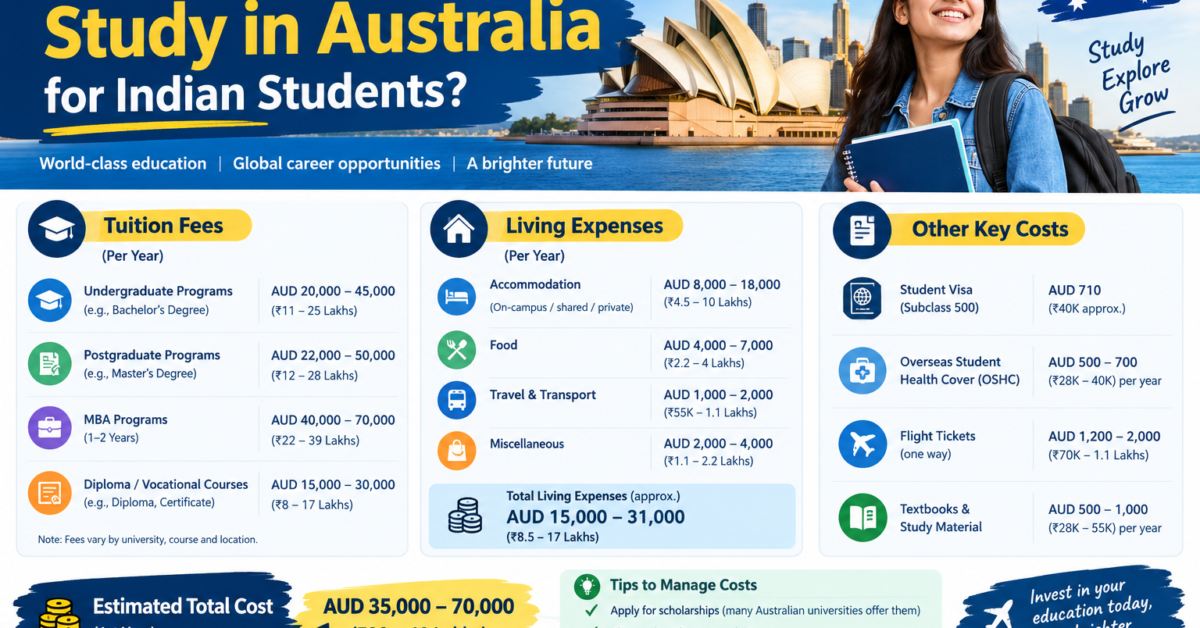
Studying in Australia after an Indian bachelor’s degree costs roughly ₹75 lakh to ₹1.2 crore for a 2-year master’s. You need a Subclass 500 visa, about A$29,710 in living-cost funds, and a specific Genuine Student statement. Most graduates then get a 2 to 3 year work visa (485). PR is possible but not guaranteed.
📌 Key Takeaways
- A 2-year master’s costs roughly ₹75 lakh to ₹1.2 crore all-in; do not plan around part-time wages. The student visa needs A$29,710 for 12 months of living costs, plus first-year tuition, health cover and airfare. The Genuine Student statement is the most common refusal point; write it yourself and make it specific. Australia caps new international enrolments, so choose courses and universities with care. The 485 work visa usually lasts 2 to 3 years and requires you to be under 35 for most applicants. PR depends on your occupation, points score and invitation rounds; treat it as an upside, not the plan. Pick in-demand fields (engineering, health, teaching, accounting, specialised IT) at universities with strong graduate outcomes.
Assumption: you hold an Indian bachelor’s degree and are considering a master’s or other postgraduate course in Australia. Written October 2026. Visa rules and fees change often. Anything marked “verify” must be checked on homeaffairs.gov.au and studyaustralia.gov.au before you pay anyone.
1. Bottom line
Australia is still a workable destination for Indian graduates, but it is no longer the easy “study, work, get PR” pipeline that agents sold five years ago. Costs are higher, visa scrutiny of Indian applicants is heavy, the government caps new international enrolments, and post-study work rights are shorter and age-limited.
It works if three conditions hold:
- You choose a field with real demand in Australia (engineering, health, IT with a strong specialisation, accounting, teaching, trades-linked degrees).
- You choose a university with credible graduate outcomes, not the cheapest offer an agent finds.
- You can fund the full cost without depending on part-time work.
It fails when people buy a visa-and-PR story, enrol in a weak course at a low-tier provider, and then find that roughly A$25 an hour does not cover rent in Sydney or Melbourne.
Key numbers to anchor on:
- All-in cost of a 2-year master’s: roughly ₹75 lakh to ₹1.2 crore (tuition plus living, at about ₹68 per A$; the rate moves, so recompute).
- Visa financial benchmark: A$29,710 for 12 months of living costs for the main applicant, on top of first-year tuition, health cover and travel.
- Post-study work visa (485): typically 2 to 3 years for most postgraduates, with an age limit under 35 for most applicants.
- PR: not guaranteed and not automatic. It depends on your occupation, points score and invitation rounds.
If your plan depends on PR to justify the debt, you have a risky plan. Treat PR as an upside, not the business case.
2. What this guide does not know about you
Advice depends on facts I do not have. Before applying these recommendations, settle these:
- Your degree and grades. A 3-year BA/BSc/BCom is treated differently from a 4-year BTech/BE by some universities. Your percentage or CGPA decides which universities will admit you.
- Your age. Over 30 changes the 485 and PR maths sharply because of the under-35 limit and the points test.
- Your budget and funding source. Savings, family income, or a bank loan lead to different visa evidence and different risk.
- Your field and work experience. Experience in a relevant field strengthens both admission and the visa narrative.
- Your goal. Skills and a global career, a specific profession, or migration. These point to different course choices.
If you cannot answer the first three, do not shortlist universities yet.
3. The current policy landscape
This is the part most agents gloss over. The system has tightened on several fronts at once.
Policy snapshot
| Area | Current position | Status |
|---|---|---|
| Student visa fee | A$2,000 from 1 Jul 2025; one source reports A$2,500 from 1 Jul 2026 | Verify |
| Enrolment cap | About 295,000 new commencements (2026 National Planning Level) | Verify for 2027 |
| Living-cost benchmark | A$29,710 per year, main applicant | Widely reported |
| Genuine Student test | Replaced the GTE test in 2024; written answers assessed | Widely reported |
| Work hours (student) | 48 hours per fortnight in session; unlimited in breaks | Widely reported |
| 485 age limit | Under 35 for most applicants | Widely reported |
| 485 English | About IELTS 6.5 overall, 5.5 per component | Verify |
Fees and caps
Visa fee. The Subclass 500 student visa application charge rose to A$2,000 from 1 July 2025. At least one Indian education site reports a further rise to A$2,500 from 1 July 2026 (with a lower fee for English-language and non-award courses). I could not confirm this on an official page. Verify the current fee on the Home Affairs site, and budget A$2,500 to be safe.
Enrolment cap. Australia set a National Planning Level of roughly 295,000 new international student commencements for 2026, allocated to institutions. The practical effect: universities have limited places, and the Department prioritises visa processing for applicants from institutions that are within their allocation. Expect more competitive admission to popular courses and uneven offer behaviour at the end of the year.
Genuine Student test and evidence level
Genuine Student requirement. The old Genuine Temporary Entrant test was replaced by the Genuine Student (GS) requirement in 2024. You answer structured questions about your circumstances, why you chose this course and provider, why Australia rather than study at home, how the course connects to your career, and your finances. Generic, templated answers get refused. This is the single most common point of failure for Indian applicants.
Evidence level. Indian applicants fall in a high-scrutiny evidence tier for many applications. In practice, that means stronger documentary proof of finances and genuine intent is expected. Verify your current tier on Home Affairs.
Money and English
Financial capacity. The benchmark is A$29,710 for 12 months of living costs for the main applicant, with additional amounts for a partner and children. You must also show first-year tuition, return airfare and overseas student health cover. Money must be accessible and have a credible history. A large deposit that appeared last month is a red flag, not proof.
English. The student visa requires roughly IELTS 6.0 overall for university study or equivalent, but universities usually require more for postgraduate courses (typically 6.5 overall with no band below 6.0, higher for law, teaching, nursing and some others). The post-study work visa requires about IELTS 6.5 overall with 5.5 in each component, or equivalent. Verify exact scores and accepted tests (IELTS, PTE Academic, TOEFL iBT, Cambridge, and others).
Work rights and processing
Work limits. Student visa holders may work up to 48 hours per fortnight while their course is in session and unlimited hours during official course breaks. Working beyond this risks cancellation of your visa.
Processing. Times vary by season and by your provider’s standing. Lodge as early as your Confirmation of Enrolment allows, and never plan a flight until the visa is granted.
Expect further changes. Australian policy on international students has moved nearly every year since 2023.
4. Who should go and who should not
Reasonable candidates
- Graduates in engineering, computing, health, accounting or education planning a course that connects to a regulated or in-demand occupation.
- Applicants with solid grades (generally 65% or above, or a strong CGPA), good English scores, and funding that does not rely on Australian wages.
- People who want an international degree, 2 to 3 years of work experience, and are happy if PR does not happen.
- People under 30 who can plan around the age limits.
Poor candidates
- Anyone whose plan is “go, work 48 hours a fortnight, cover costs.” The arithmetic does not work in expensive cities.
- Applicants choosing a course only because it is cheap or has easy admission. Weak providers produce weak graduate outcomes and weak GS narratives.
- Applicants over 33 or 34 who need the 485. Check the age rule before enrolling.
- Anyone whose visa evidence includes borrowed money parked temporarily, forged documents, or agent-written statements of purpose they cannot defend in an interview.
- Students taking a vocational or low-level course as a backdoor to stay. The government has targeted this pattern, and it increases refusal risk.
Quick fit check
| Profile | Verdict | Reason |
|---|---|---|
| Engineering or health graduate, 65%+, funded without wages | Strong | Clear occupation, accreditation and demand |
| Accounting or IT graduate with a specialised course | Reasonable | Competitive entry-level market; needs internships |
| Regional university in a high-demand field | Good if you live regionally | Lower cost and extra post-study time, but fewer jobs |
| Age 33 or older needing the 485 | Weak | Under-35 limit may block post-study work |
| Generic business degree at a low-ranked private college | Avoid | Poor outcomes and high refusal risk |
| Plan depends on part-time wages to pay rent | Do not go | 48 hours per fortnight does not cover big-city costs |
5. Choosing a course and university
Start with the occupation, not the university. Ask what job you want and whether it is on Australia’s skilled occupation lists (the Core Skills Occupation List for employer-sponsored work, and the relevant skilled migration lists for PR). Then find courses that lead there. Check this on the Home Affairs and Jobs and Skills Australia sites.
Fields with the clearest demand
- Engineering (civil, electrical, mechanical, mining, software). Pick a course accredited by Engineers Australia so your qualification is recognised for professional work and skills assessment.
- Health and nursing. Heavily regulated (AHPRA registration), strong demand, but registration requirements and English thresholds are strict.
- Teaching. Genuine shortages, but registration and placement requirements apply.
- Accounting. Needs recognised professional body accreditation (CPA Australia, CAANZ). The market is more competitive than it was.
- IT and data. Demand exists, but entry-level competition is intense. A generic “Master of IT” is weaker than a specialised degree in cybersecurity, data engineering, AI or cloud, combined with internships.
Be sceptical about: generic business, marketing and management degrees at low-ranked providers. They are marketed hard, graduate outcomes are poor, and they are exactly the profile the Department scrutinises.
University tiers in practice
- Group of Eight (Melbourne, Sydney, ANU, UNSW, Monash, Queensland, Adelaide, UWA). Highest cost and entry bar, strongest employer recognition. Worth it if you can afford it and your grades qualify.
- Strong mid-tier universities (UTS, RMIT, Macquarie, Deakin, QUT, Griffith, Curtin, UniSA, Swinburne, Wollongong, Newcastle and others). Often the best value. Pick based on the specific course’s employer links, accreditation and placement record rather than overall ranking.
- Regional universities and campuses. Lower living costs, often easier admission, and potential extra post-study work time and PR points for regional study and living. The trade-off is fewer jobs and internships, and you must actually live regionally to benefit. Verify which postcodes qualify.
- Private colleges and pathway providers. Treat with caution. Check CRICOS registration, the provider’s record, and whether the credits transfer. Many “cheap pathways” add a year of cost for no benefit.
University tier comparison
| Tier | Cost level | Entry bar | Main strength | Main trade-off |
|---|---|---|---|---|
| Group of Eight | Highest | 70%+ typical for competitive courses | Employer recognition | Cost and competition |
| Strong mid-tier | Mid to high | 60% to 70% typical | Best value; course-level employer links | Quality varies by course |
| Regional university | Lower tuition and living cost | Often easier | Extra 485 time and PR points if you live regionally | Fewer jobs and internships |
| Private college or pathway | Varies; often adds a year | Easy | Easy admission | Weak outcomes; credit transfer risk |
Course length and credits. Most coursework master’s degrees run 1.5 to 2 years. Some universities shorten a master’s for relevant prior study or accept a 3-year Indian bachelor’s into a 2-year master’s, while others require a 4-year degree or a graduate diploma first. Australia and India have a qualification recognition arrangement, but individual universities still set their own rules. Ask each university in writing how it treats your specific degree.
Check before you apply
- CRICOS registration of the course and the provider.
- Professional accreditation relevant to your career.
- Graduate outcomes: the Australian Government’s QILT website publishes graduate employment and salary data by university and field.
- Work-integrated learning, internships or a practicum.
- Location cost: a cheaper degree in an expensive city is not cheaper.
6. Admission requirements
Exact thresholds vary, so confirm each university’s page. Typical requirements for a postgraduate coursework degree:
- Academic: a recognised bachelor’s degree, usually with 60% to 70% or higher depending on the university. Top universities expect higher, often 70% to 75% or above for competitive courses.
- English: IELTS 6.5 overall (no band below 6.0) or equivalent is common. Some courses require 7.0.
- Documents: passport, transcripts and degree certificates (often with attestation or verification), CV, statement of purpose, references, and work experience letters if relevant.
- Extra requirements: some courses ask for interviews, portfolios, GMAT or work experience (MBA), or specific prerequisite subjects.
Statement of purpose. Write it yourself. It should explain why this course, why this university, how it fits your background, and what you will do afterwards. Reuse of agent templates is easy to detect and hurts both admission and your GS assessment.
Offers. You will first receive an offer letter, often conditional. After accepting and paying a deposit, you receive a Confirmation of Enrolment (eCoE), which you need to lodge the visa. Read the refund policy before paying a deposit.
Intakes. The main intakes are February/March and July, with some universities offering November or other starts. Today’s date matters here: if you are applying now, February/March 2027 is the realistic next intake for many courses, and the July 2027 intake is the planning target if you need more time.
Intake timing (approximate)
| Intake | Classes start | Start applying | Aim to lodge visa |
|---|---|---|---|
| Semester 1 | Late Feb to March | 6 to 8 months before | 2 to 3 months before |
| Semester 2 | July | 6 to 8 months before | 2 to 3 months before |
| Other starts (some universities) | Oct to Nov | Check each university | Check each university |
Document checklist
| Document | Used for | Note |
|---|---|---|
| Passport | Admission and visa | Valid beyond your course end |
| Transcripts and degree certificates | Admission | Some universities ask for verification |
| English test score | Admission and visa | Check validity (usually 2 years) |
| Statement of purpose, CV, references | Admission | Write the SOP yourself |
| Offer letter and eCoE | Visa | eCoE issued after acceptance and deposit |
| Overseas Student Health Cover | Visa | Must cover the full visa period |
| Financial evidence | Visa | Documented history, accessible funds |
| Genuine Student answers | Visa | Specific, personal, consistent with your records |
| Medical exam and police clearance | Visa | When requested |
7. The real cost
Take the visa benchmark as the floor, not the budget.
Cost summary (approximate; verify)
| Cost item | Amount (A$) | Approx. in ₹ at ₹68 per A$ |
|---|---|---|
| Tuition per year | 30,000 to 55,000 | ₹20 to 37 lakh |
| Living costs per year (visa benchmark) | 29,710 and up | ₹20 lakh and up |
| Student visa fee | 2,000 to 2,500 | ₹1.4 to 1.7 lakh |
| Health cover per year (single) | 600 to 700 | ₹41,000 to 48,000 |
| Return airfare | Not applicable | ₹70,000 to 1,20,000 |
| First-month settling costs | 2,000 to 4,000 | ₹1.4 to 2.7 lakh |
| Total for a 2-year master’s | 110,000 to 170,000 | ₹75 lakh to 1.16 crore |
Tuition and living costs
Tuition. Postgraduate coursework fees commonly range from about A$30,000 to A$55,000 per year, depending on the university and field. Top universities and fields such as engineering, medicine-related courses and MBAs cost more. A 2-year master’s therefore often totals A$60,000 to A$100,000 or more, which is roughly ₹41 lakh to ₹68 lakh or higher.
Living costs. The visa benchmark is A$29,710 a year. In Sydney and Melbourne, realistic spending is often higher, particularly when rent is high. Smaller cities and regional areas can be cheaper. Budget by city rather than by the visa number.
One-time and recurring costs
- Student visa application charge: A$2,000 to A$2,500.
- Overseas Student Health Cover: often around A$600 to A$700 a year for a single student; multi-year policies cost more up front.
- Return airfare: ₹70,000 to ₹1,20,000 depending on timing.
- English test: IELTS or PTE fee, often ₹16,000 to ₹20,000, possibly with retakes.
- Application fees, document verification, medical examination and police clearance.
- Initial settling costs: bond (typically four weeks of rent), furniture, bedding, transport card and first-month groceries. Plan for A$2,000 to A$4,000 in the first month before income.
- Ongoing: rent, groceries, phone, public transport, textbooks, and a buffer for emergencies.
Income, total cost and return
Working income, realistically. At about A$25 an hour or more, a full 48 hours per fortnight earns roughly A$1,200 gross a fortnight. That helps, but it does not cover rent and food in a large city, and jobs are not guaranteed. Many students find part-time work takes weeks or months. Hospitality, retail, delivery and warehouse jobs are the common entry points, and relevant-field jobs are harder to get while studying. Do not build your finances around expected earnings.
Full picture for a 2-year master’s. Tuition of A$60,000 to A$100,000 plus living costs of A$50,000 to A$70,000 gives about A$110,000 to A$170,000 before income. At roughly ₹68 per A$, that is around ₹75 lakh to ₹1.2 crore. The exchange rate and your city can shift this significantly.
Return on investment. Entry-level graduate salaries in fields like engineering, IT and accounting commonly sit somewhere around A$65,000 to A$90,000, depending on the field and city, but many international graduates spend months in non-field work first. A tenth of that outcome varies by market conditions. Run your own scenario: if you return to India and earn, say, ₹10 to ₹18 lakh per year, how long does it take to recover the cost? If the answer is more than 5 to 7 years without PR, the maths is weak.
8. Financing
- Savings and family funds. Cleanest for the visa if the funds have a documented history. Avoid short-term deposits and unexplained transfers.
- Education loans from Indian banks. Common route. Check collateral requirements (larger loans typically need property or guarantees), interest rates, moratorium periods, and whether the lender’s sanction letter is acceptable for visa purposes.
- Scholarships. Competitive, but worth pursuing. Check university merit awards, the Australia Awards programs, and country-specific scholarships. Many partial scholarships reduce tuition by 10% to 25%, which matters.
- Tax on remittances from India. Rules on tax collected at source for overseas education payments have changed in recent budgets and differ for loan-funded and self-funded payments. Verify the current rule with your bank before transferring tuition.
Funding options compared
| Source | Strength | Risk | Visa note |
|---|---|---|---|
| Savings and family funds | No debt | Large sudden deposits look suspicious | Needs documented history |
| Education loan (Indian bank) | Spreads the cost | Collateral, interest, repayment pressure | Sanction letter must be acceptable |
| Scholarship | Cuts tuition, often 10% to 25% | Competitive; not guaranteed | Use only if confirmed in writing |
| Informal or short-term loans | Quick | High interest; looks like parked money | Avoid |
Risks to call out: do not borrow beyond what you could repay on an Indian salary if PR fails. Do not take informal loans with high interest. Do not rely on a future scholarship that is not confirmed in writing.
9. Visa application, step by step
- Shortlist and apply to universities. Keep copies of everything.
- Receive an offer, accept it, and pay the deposit. Get the eCoE.
- Arrange overseas student health cover. It must cover your entire visa period.
- Complete the English test if not already done.
- Prepare financial evidence. Bank statements with history, loan sanction letters, income proof of sponsors, and a clear funding explanation. Use accessible funds.
- Complete the Genuine Student questions in your own words. Be specific: reference your degree, work history, why this course adds to it, why Australia, and what you will do afterwards in India or elsewhere.
- Lodge online via ImmiAccount and pay the fee.
- Complete health examinations and biometrics when requested, and provide police clearance if asked.
- Respond promptly to any request for further information.
- After grant, check conditions, plan travel, and arrange accommodation for the first weeks.
Common refusal reasons for Indian applicants
- Weak or generic GS answers.
- Course choice that does not match prior study or work, with no explanation.
- Financial evidence that looks recently arranged or unverifiable.
- Intending to use study as a route to migration, which the GS test is designed to catch.
- Forged or misleading documents. This can lead to a ban on future applications and long-term consequences.
Refusal reasons and how to reduce the risk
| Reason | What reduces the risk |
|---|---|
| Generic Genuine Student answers | Write specific answers tied to your degree, work and career plan |
| Course unrelated to your background | Explain the link, or choose a related course |
| Financial evidence looks recent or unverifiable | Show a funding history and accessible funds |
| Migration intent over study intent | Show a credible career plan and ties |
| Forged or misleading documents | Submit only genuine documents; a ban is possible |
If you use an agent, check that they are registered with the Australian Migration Agents Registration Authority (OMARA) for visa advice. Many education agents are not licensed to give migration advice. Do not let anyone submit your visa application without you reading every answer.
10. Working while you study
- Up to 48 hours per fortnight in session; unlimited during official breaks. Know your university’s teaching calendar.
- Pay rates are governed by awards and the national minimum wage. If an employer pays you cash below award rates, that is wage theft, and you can report it to the Fair Work Ombudsman. Student visa holders are protected regardless of immigration status.
- Use the university career service, internships, student ambassador roles and course-linked placements. Jobs in your field, even part-time or unpaid-adjacent placements, matter more for your career than extra shifts.
- Do not exceed the hours limit. Breaches can lead to visa cancellation and ruin later applications.
11. After graduation: 485, employer sponsorship and PR
Post-study work: Subclass 485
Temporary Graduate visa (Subclass 485). This is the post-study work visa, with full work rights and no restriction on hours or employer. Key points:
- Apply within 6 months of completing your course, while holding a student visa or a visa with study rights.
- Age limit under 35 for most applicants, with exceptions for certain research graduates (check the current list).
- English requirement around IELTS 6.5 overall with 5.5 in each component, or equivalent.
- Stay period for most higher-education graduates is typically about 2 years for a bachelor’s or coursework master’s, and longer for research master’s and doctoral graduates. Some sources say the India–Australia trade agreement gives Indian graduates extra time. I could not confirm the exact current India-specific durations, so verify on Home Affairs.
- A second 485 can be available to those who studied and lived in a designated regional area, adding 1 to 2 years.
- The visa application fee is high (several thousand dollars). Verify the current charge.
What the 485 is for. It buys time to find skilled work, build local experience, and improve your PR points. It is not itself a path to PR, and the clock is short.
Employer sponsorship and points-tested PR
Employer sponsorship. The main sponsored visa is the Skills in Demand visa (Subclass 482), which replaced the older temporary skill shortage visa. You need a job offer from an approved sponsor, an occupation that qualifies, and typically relevant experience. Some sponsored pathways can lead to PR later.
Points-tested skilled migration. The main permanent options are the Skilled Independent (189), Skilled Nominated (190) and Skilled Work Regional (491, provisional) visas. You lodge an expression of interest, and invitations are issued in rounds.
- The pass mark is 65 points, but invitation cut-offs for competitive occupations are usually much higher.
- Points come from age (peak at 25 to 32), English proficiency (competent, proficient, superior), skilled work experience, education, Australian study, regional study, professional year, community language credential, partner skills and state nomination.
- Your occupation must be on the relevant list, and you usually need a positive skills assessment from the assessing authority for that profession.
- Reaching 65 points does not mean you will be invited. For many occupations, invitations go to applicants with far more.
Pathways at a glance
| Pathway | Suits | Key requirement | Main risk |
|---|---|---|---|
| 485 Temporary Graduate | Recent graduates | Apply within 6 months; under 35; English test | Short clock; no PR by itself |
| 482 Skills in Demand | Those with a sponsor | Job offer; eligible occupation | Depends on employer |
| 189 Skilled Independent | High-points applicants | Occupation on list; skills assessment; invitation | Very competitive |
| 190 Skilled Nominated | Those nominated by a state | State nomination | State criteria change |
| 491 Skilled Work Regional | Those willing to live regionally | Regional nomination or sponsorship | Regional residence obligations |
Points test: main factors (approximate; verify)
| Factor | Points |
|---|---|
| Age 25 to 32 | 30 |
| Age 18 to 24 or 33 to 39 | 25 |
| English: proficient / superior | 10 / 20 |
| Bachelor or master’s degree | 15 |
| Doctorate | 20 |
| Australian study requirement | 5 |
| Regional study | 5 |
| Professional year | 5 |
| Community language credential | 5 |
| State nomination: 190 / 491 | 5 / 15 |
| Pass mark | 65 |
What this means for you. If you want PR, work backwards before choosing a course: which occupation, which assessing body, which list, what points you will realistically have, and in which state. If you cannot answer these, you are guessing.
Realistic outcomes for Indian graduates
- Some get skilled jobs, build experience, and obtain sponsorship or PR within 3 to 6 years.
- Many work in jobs unrelated to their degree for part of the 485, then return to India or move elsewhere.
- Some are caught by age limits, lower-than-needed points, or a changed occupation list.
Plan for the second and third group to be you. Then any better outcome is a bonus.
12. Risks and mistakes to avoid
- Choosing an agent on commission. Agents are often paid by universities, so their advice can lean toward whoever pays best. Ask directly which institutions pay them and compare their suggestions with your own research.
- Applying to too few or too many universities. Apply to a spread: a few reach, a few target, a few safe. Over-applying scatters your SOP quality.
- Confusing a visa pass with a career. Getting the visa is the start. Employability depends on skills, English, networking and local experience.
- Underestimating housing. Rental markets are tight in major cities. Book temporary accommodation for 3 to 4 weeks, avoid paying deposits for properties you have not inspected, and beware of rental scams.
- Ignoring policy risk. Fees, caps and rules change fast. A course that starts in 18 months may sit under different rules. Keep a buffer.
- Taking on excessive debt. If repayment depends on a high Australian salary that is not guaranteed, you are betting your family’s finances.
- Bad documentation. Forged or inconsistent documents lead to refusal, and sometimes bans. Never let anyone alter your bank statements or certificates.
- Ignoring health and mental load. Distance, rent stress, and job hunting are tough. Contact your university’s student support early if you struggle, and use OSHC for medical care.
- Missing the 485 deadline or age cut-off. Calendar both from day one.
- Assuming part-time work will bridge the gap. It might help, but a plan that needs it to work is fragile.
13. Timeline for the next intake
It is October 2026. If you want to start in February or March 2027, this is tight but possible. Work back from the date:
| Window | Task |
|---|---|
| Now to 2 weeks | Settle goal, budget and shortlist of 3 to 6 courses; book English test; request transcripts and certificates |
| Weeks 2 to 6 | Submit applications and SOP; research scholarships; speak to a bank if you need a loan |
| Weeks 4 to 10 | Receive and compare offers; accept one; pay the deposit; get the eCoE |
| Weeks 8 to 12 | Buy health cover; finalise financial evidence; complete Genuine Student answers; lodge the visa |
| Weeks 10 to 16 | Medical, biometrics and further requests; wait for the decision |
| After grant | Book flights, temporary accommodation and airport pickup; arrive before orientation |
If this schedule does not work, aim for the July 2027 intake and use the extra time to improve your English score, grades, SOP and finances. A late, rushed application is more likely to be a poor one.
14. Alternatives to compare
Do not decide on Australia without comparing at least two other options.
| Option | Strength | Watch-out |
|---|---|---|
| Germany | Very low or no tuition at public universities; strong engineering | Language and living-cost requirements; slow job entry |
| Ireland | English-speaking; strong tech and pharma employers | Expensive, tight accommodation |
| UK | One-year master’s; graduate route | Cost and recent policy changes |
| Canada | Large, familiar market | Caps and tightening reduce predictability |
| New Zealand | Easier lifestyle; lower cost in some cities | Smaller market, fewer large employers |
| Top Indian programme (IIT, IIM, similar) | Lower cost; strong brand | Fewer international exposure options |
The best option is the one that gives you the strongest outcome per rupee spent and the least dependence on policy luck.
15. Final verdict and what to do this week
Australia makes sense for a prepared, funded, and realistic applicant in a high-demand field. It does not make sense as a speculative bet on PR or as a shortcut around weak grades.
Do these in order:
- Write down your goal in one sentence and the occupation you are targeting.
- Fix your budget using the all-in numbers above. If you cannot afford the low end without risky borrowing, stop and reconsider.
- Check your age against the 485 rule and decide how much PR matters.
- Shortlist 3 to 6 courses with accreditation, graduate outcomes (QILT) and cost per year.
- Book or retake your English test to reach at least IELTS 6.5 overall, ideally with a margin.
- Email universities directly to confirm how they treat your degree and what scholarships exist.
- Draft your own SOP and GS answers before involving any agent.
- Verify every fee, requirement and rule on official government pages. Use agent claims only as leads, not as proof.
If you share your degree, percentage, age, field, budget and target city, I can narrow this to a specific shortlist and a realistic cost estimate.
Official sources to verify
- Department of Home Affairs: Student visa (Subclass 500), Temporary Graduate visa (Subclass 485), Skilled migration, and the Genuine Student requirement.
- Study Australia (studyaustralia.gov.au): costs, scholarships and course search.
- CRICOS register: confirms provider and course registration.
- QILT (qilt.edu.au): graduate outcomes by university and field.
- OMARA: register of licensed migration agents.
- Fair Work Ombudsman: pay rates and worker rights.
Helpful answers
Frequently asked questions
Can I study in Australia after completing my graduation in India?
Yes, Indian students can pursue postgraduate courses in Australia, including master's degrees, graduate diplomas and other eligible programs, depending on their academic qualifications and university admission requirements.
Which courses can I study in Australia after graduation?
Popular options include master's degrees in business administration, information technology, engineering, data science, healthcare, finance, and project management. The best course depends on your previous degree and career goals.
What are the eligibility requirements for studying in Australia after graduation?
Generally, students need a recognised bachelor's degree, proof of English-language proficiency where required, academic transcripts and other documents specified by the university. Some courses may require relevant work experience or additional qualifications.
How much does it cost to study in Australia after graduation?
Tuition fees vary by university and course. Students should also budget for accommodation, food, transport, health insurance and other living expenses. Check the university's official fee schedule and current Australian student visa financial requirements before applying.
Can Indian students get scholarships for postgraduate studies in Australia?
Yes, eligible Indian students can apply for university scholarships, merit-based awards and other funding opportunities. Availability and eligibility depend on the institution, course and academic performance.
Can I work while studying in Australia after graduation?
International students holding an eligible Student visa can generally work up to 48 hours per fortnight while their course is in session, subject to visa conditions. Different rules may apply during scheduled course breaks.
Can I stay in Australia after completing my postgraduate degree?
Eligible graduates may be able to apply for a Temporary Graduate visa (subclass 485). Eligibility depends on factors such as the qualification completed, age, visa history and other applicable requirements.
Is IELTS compulsory for studying in Australia after graduation?
Not always. Many universities require IELTS or another accepted English-language test, but some may offer exemptions or accept alternative evidence. Requirements vary by institution, course and visa category.
Which Australian universities are best for postgraduate studies?
The right university depends on your chosen subject, tuition budget, admission requirements and career plans. Compare course content, accreditation, graduate outcomes, location and scholarship opportunities before making a decision.
Can I get permanent residency in Australia after completing my studies?
Yes, some graduates may qualify for permanent residency through eligible skilled migration or employer-sponsored pathways. However, completing a degree in Australia does not guarantee permanent residency; applicants must meet the relevant visa criteria.