How Much Does It Cost to Study in Australia for Indian Students
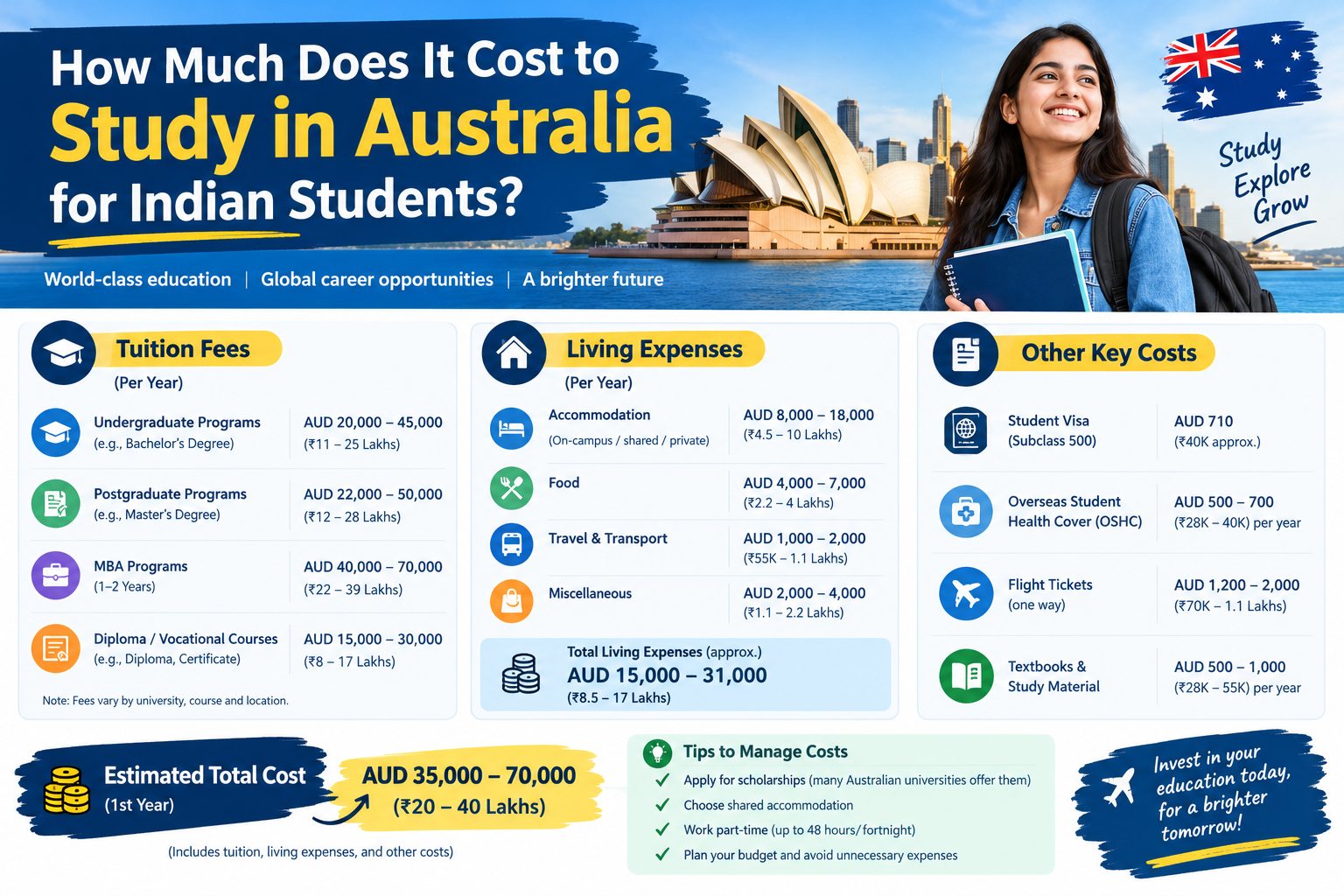
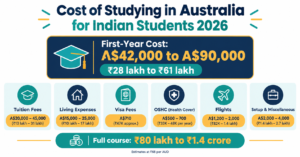
Studying in Australia costs most Indian students about A$42,000-90,000 (₹28-61 lakh) in the first year, and ₹80 lakh to ₹1.4 crore for the full course. Tuition (A$30,000-55,000 a year) and city rent decide most of the difference, and the student visa requires proof of A$29,710 for living costs plus first-year tuition and travel.
⚡ Quick Answer
Studying in Australia typically costs an Indian student A$42,000–90,000 (about ₹28–61 lakh) in the first year, covering tuition, living costs, visa, health cover and flights. A full course costs roughly ₹80 lakh to ₹1.4 crore, depending on the university, city and degree level. The visa requires proof of A$29,710 for living costs plus first-year tuition and travel.
📌 Key Takeaways
- First-year cost for most Indian students is ₹28–61 lakh (A$42,000–90,000). Full-course cost ranges from about ₹80 lakh to ₹1.4 crore. Tuition is the biggest cost: A$30,000–55,000 a year for most degrees. Living costs run A$20,000–42,000 a year, with Sydney the most expensive and regional cities the cheapest. The visa needs proof of A$29,710 for living costs, plus first-year tuition and travel. The student visa fee was A$2,000 and is reported as A$2,500 from 1 July 2026. Confirm on the Home Affairs site. Part-time work (48 hours per fortnight) offsets rent and groceries, not tuition. Regional and mid-tier universities can save ₹15–25 lakh over a two-year master’s. Use registered agents only, and never rely on a guaranteed visa claim. Add a 10% buffer for fee increases and rupee depreciation.
Studying in Australia costs most Indian students between ₹40 lakh and ₹65 lakh for the first year alone, and between ₹80 lakh and ₹1.4 crore for the full course. The range is wide because three variables decide almost everything: the course level, the university tier, and the city. This guide breaks down every cost line, shows four worked budgets, explains how to fund the total, and lists exactly who can help you at each stage.
If you only have a rough budget in mind, read the summary table first, then jump to the section that matches your biggest cost.
Quick Summary: Total Cost at a Glance
| Cost Item | Typical Range (AUD) | Approx. INR (at ₹68 per AUD) |
|---|---|---|
| Tuition per year | 15,000 to 55,000 | ₹10.2 lakh to ₹37.4 lakh |
| Living costs per year | 22,000 to 40,000 | ₹15 lakh to ₹27.2 lakh |
| Student visa application fee | 2,000 to 2,500 (reported 2,500 from 1 July 2026) | ₹1.36 lakh to ₹1.7 lakh |
| Overseas Student Health Cover (OSHC), per year | 500 to 700 | ₹34,000 to ₹47,600 |
| Return flight from India | 1,000 to 1,800 | ₹68,000 to ₹1.22 lakh |
| One-time setup costs | 1,000 to 2,500 | ₹68,000 to ₹1.7 lakh |
| Realistic first-year total | 40,000 to 95,000 | ₹27 lakh to ₹65 lakh |
Exchange rate assumption: this guide uses ₹68 per AUD as a planning figure. Check the live rate on the day you budget. A 5% rupee swing changes a ₹60 lakh budget by ₹3 lakh.
Why the Cost Varies So Much
Two students can both say they are studying in Australia and spend a completely different amount. The difference comes from:
- Course level: a vocational diploma costs a fraction of a master’s degree.
- Field of study: medicine, dentistry, veterinary science and some engineering courses cost far more than arts or business.
- University tier: the Group of Eight research universities charge more than mid-tier and regional universities.
- City: Sydney and Melbourne rent is much higher than Adelaide, Perth, Hobart or regional towns.
- Course length: a 3-year bachelor’s degree or a 2-year master’s multiplies the annual cost, and fees rise each year.
- Lifestyle: shared housing and home cooking versus a private studio and eating out.
1. Tuition Fees in Australia for International Students
Tuition is the largest single cost for most students. International fees are set by each university, are not capped by the government, and are published per course on the university website.
1.1 Tuition by Course Level
| Course Level | Duration | Typical Annual Fee (AUD) | Approx. Annual Fee (INR) |
|---|---|---|---|
| English language course (ELICOS) | 10 to 48 weeks | 300 to 450 per week | ₹20,400 to ₹30,600 per week |
| Vocational (VET) certificate or diploma | 1 to 2 years | 10,000 to 22,000 | ₹6.8 lakh to ₹15 lakh |
| Foundation or pathway program | 6 to 12 months | 20,000 to 32,000 | ₹13.6 lakh to ₹21.8 lakh |
| Bachelor’s degree | 3 to 4 years | 30,000 to 50,000 | ₹20.4 lakh to ₹34 lakh |
| Master’s by coursework | 1.5 to 2 years | 32,000 to 55,000 | ₹21.8 lakh to ₹37.4 lakh |
| MBA | 1 to 2 years | 50,000 to 100,000 or more (total) | ₹34 lakh to ₹68 lakh or more |
| PhD / research degree | 3 to 4 years | 30,000 to 50,000 (often fully offset by a scholarship) | See scholarships section |
1.2 Tuition by Field of Study
| Field | Typical Annual Fee (AUD) | Comment |
|---|---|---|
| Business, commerce, arts, humanities | 30,000 to 42,000 | Lowest range for degree-level study |
| Information technology, data science | 33,000 to 48,000 | Heavily subscribed by Indian students |
| Engineering | 38,000 to 55,000 | Higher lab and equipment costs |
| Health sciences, nursing | 35,000 to 50,000 | Clinical placement costs may apply |
| Law | 40,000 to 60,000 | Varies sharply by university |
| Medicine, dentistry, veterinary science | 70,000 to 110,000 | Very limited international places |
1.3 Tuition by University Group
| University Group | Examples | Cost Position |
|---|---|---|
| Group of Eight | Melbourne, Sydney, ANU, UNSW, Monash, UQ, Adelaide, UWA | Highest fees, strongest rankings |
| Mid-tier metropolitan | UTS, RMIT, Deakin, Macquarie, Curtin, QUT | Mid to high fees, strong industry links |
| Regional and smaller universities | Charles Sturt, UNE, Southern Cross, University of Tasmania, Federation | Lower fees, lower living costs |
Pick the university by course fit and graduate outcomes, not by ranking alone. A ₹15 lakh fee difference should be justified by a concrete advantage such as a specific accreditation or an industry partnership.
1.4 Fees Rise Every Year
Most universities increase international fees by roughly 3% to 6% annually. Always calculate the full course at a higher fee than the first-year price. A master’s fee of AUD 45,000 in year one can be about AUD 47,000 to 48,000 in year two.
1.5 Fees You Pay Beyond Tuition
- Student services and amenities fee (SSAF): capped by the government at around AUD 350 to 400 per year at most universities.
- Materials and lab fees: some courses charge extra for equipment, software or field trips.
- Textbooks: AUD 500 to 1,500 per year, much less if you use library and second-hand copies.
- Course deposit: most universities require a deposit (often one semester’s fees) before issuing the Confirmation of Enrolment (CoE). It is usually credited toward your tuition.
2. Visa and Compulsory Costs
These costs are not optional. Without them you cannot obtain or keep a student visa.
| Cost | Approximate Amount (AUD) | Approx. INR | Notes |
|---|---|---|---|
| Student visa (subclass 500) application charge | 2,000 to 2,500 | ₹1.36 lakh to ₹1.7 lakh | Was AUD 2,000 from 1 July 2025; sources report AUD 2,500 for applications lodged from 1 July 2026. Confirm on the Home Affairs website. |
| Overseas Student Health Cover (OSHC) | 500 to 700 per year (single) | ₹34,000 to ₹47,600 | Mandatory for the full visa duration; you pay for the whole period upfront |
| Medical examination (panel physician in India) | Around ₹7,000 to ₹12,000 | Paid in INR | Required for most applicants staying over 6 months |
| Police clearance certificate | Low (a few hundred rupees) | Needed in many cases | |
| English test (IELTS, PTE, TOEFL) | Around ₹16,000 to ₹19,000 per attempt | Paid in INR | Retakes add up if your score is below the requirement |
| University application fee | 0 to 150 | Up to ₹10,200 | Many universities waive it |
| Biometrics, courier, document attestation | Small | Budget a few thousand rupees |
2.1 The Financial Capacity Requirement
The government requires proof that you can pay for your first year of study without depending on illegal work. As of the figures published in 2024 and still widely cited in 2026, the living-cost component is AUD 29,710 for the main applicant. Check the Home Affairs student visa financial capacity page for any later increase.
You must show funds covering all of these:
| Component | Requirement (AUD) |
|---|---|
| Living costs for the main applicant, 12 months | 29,710 |
| Living costs for a partner (if accompanying) | About 10,394 |
| Living costs for each child (if accompanying) | About 4,449 |
| Schooling for each school-age child | About 13,502 |
| First-year tuition fees | As stated on your CoE |
| Return travel | Typically around 2,000 as a planning amount |
For a single student with a AUD 40,000 tuition fee, the visa evidence requirement is roughly AUD 71,000 to 72,000 (about ₹48 lakh to ₹49 lakh). This is separate from, and in addition to, the visa fee.
2.2 Why Indian Applicants Need Extra Care
Indian applicants face close scrutiny of financial evidence and of the Genuine Student (GS) assessment, which replaced the earlier Genuine Temporary Entrant test. Common problems:
- Large deposits that appear shortly before the application with no history behind them.
- Funds that cannot be traced to a plausible source such as salary, business income, savings or a bank loan.
- Generic or copied statements of purpose that do not explain why this course, this provider and this country make sense.
- Course choices that do not logically follow from your previous study or work.
Financial evidence that looks assembled for the visa, rather than built over time, is the most common way a well-qualified student gets refused.
3. Living Costs in Australia
The AUD 29,710 government figure is a minimum for visa purposes. It is not a realistic budget in Sydney or Melbourne, and it can be enough in a smaller city if you live carefully.
3.1 Typical Monthly Expenses
| Expense | Monthly (AUD) | Monthly (INR) |
|---|---|---|
| Shared rent (room in a shared flat or house) | 800 to 1,600 | ₹54,400 to ₹1.09 lakh |
| Groceries and cooking at home | 350 to 650 | ₹23,800 to ₹44,200 |
| Public transport | 100 to 220 | ₹6,800 to ₹15,000 |
| Mobile and internet | 40 to 90 | ₹2,700 to ₹6,100 |
| Electricity, gas, water (if not included in rent) | 80 to 180 | ₹5,400 to ₹12,200 |
| Eating out, entertainment, personal items | 200 to 450 | ₹13,600 to ₹30,600 |
| Miscellaneous (clothing, medical co-payments, emergencies) | 100 to 250 | ₹6,800 to ₹17,000 |
| Total per month | 1,670 to 3,440 | ₹1.14 lakh to ₹2.34 lakh |
Multiply by 12 and you get roughly AUD 20,000 to 41,000 a year. That range matches the real spread between regional cities and Sydney.
3.2 Accommodation Costs by Type
| Accommodation Type | Weekly Cost (AUD) | Comment |
|---|---|---|
| University residential college (catered) | 350 to 600 | Most expensive, meals included, easier first year |
| Purpose-built student accommodation | 300 to 550 | Furnished, bills often included, high price |
| Private studio or one-bedroom | 350 to 600 or more | Best privacy, worst for budget |
| Shared room in a flat or house | 150 to 300 | Cheapest, but check lease and bond terms |
| Homestay (living with a local family) | 250 to 400 | Meals often included, useful for the first few months |
Rental bond is typically four weeks of rent, refundable if you leave the property in good condition. Keep the receipt and take photos at move-in.
3.3 Living Costs by City
| City | Estimated Annual Living Cost (AUD) | Estimated Annual Living Cost (INR) | Notes |
|---|---|---|---|
| Sydney | 33,000 to 42,000 | ₹22.4 lakh to ₹28.6 lakh | Highest rent in the country |
| Melbourne | 28,000 to 38,000 | ₹19 lakh to ₹25.8 lakh | Large student population, good transport |
| Brisbane | 26,000 to 35,000 | ₹17.7 lakh to ₹23.8 lakh | Rising rents, milder than Sydney |
| Perth | 26,000 to 35,000 | ₹17.7 lakh to ₹23.8 lakh | Tight rental market in recent years |
| Canberra | 27,000 to 36,000 | ₹18.4 lakh to ₹24.5 lakh | Compact, rent not cheap |
| Adelaide | 23,000 to 31,000 | ₹15.6 lakh to ₹21.1 lakh | Lower rent, smaller job market |
| Hobart | 23,000 to 31,000 | ₹15.6 lakh to ₹21.1 lakh | Limited rental stock |
| Regional towns | 20,000 to 28,000 | ₹13.6 lakh to ₹19 lakh | Cheapest, fewer part-time jobs |
These are planning estimates. Rents move quickly. Check current listings on the major Australian rental portals and the student accommodation pages of your target university.
3.4 Food, Transport and Daily Costs
- Groceries: AUD 80 to 150 a week if you cook at home. Indian grocery stores in the major cities keep staple costs reasonable.
- Eating out: a basic meal costs AUD 15 to 25. Eating out four times a week adds AUD 240 to 400 a month.
- Transport: fares vary by state, and concession eligibility for international students differs between states. Confirm with the local transport authority before assuming a discount.
- Phone: prepaid and monthly plans from AUD 20 to 50 are common.
4. One-Time Arrival and Setup Costs
Budget these in addition to annual costs.
| Item | Approximate Cost (AUD) |
|---|---|
| Rental bond (four weeks) | 600 to 1,600 |
| First week of temporary accommodation | 300 to 700 |
| Bedding, kitchen basics, small furniture | 300 to 700 |
| Laptop or equipment (if not already owned) | 800 to 1,800 |
| Winter clothing (if arriving for a cold-season intake) | 200 to 500 |
| Airport transfer and SIM card | 80 to 200 |
| Typical one-time total | 1,000 to 2,500 (excluding laptop) |
5. Flights and Travel Costs
Return flights from Delhi, Mumbai, Bengaluru, Chennai or Hyderabad to Sydney, Melbourne or Perth typically cost AUD 1,000 to 1,800 (₹68,000 to ₹1.22 lakh). Prices spike in December and January and around intake dates.
- Book at least 2 to 3 months ahead for February and July intakes.
- Budget at least one return trip home across a 2-year degree, and ideally one per year.
- Excess baggage fees add AUD 100 to 300 if you travel with more than the standard allowance.
6. Four Sample Budgets
These show how the numbers combine. They use the ₹68 per AUD assumption.
6.1 First-Year Budget Comparison
| Cost (AUD) | Scenario A: Diploma, regional city | Scenario B: Bachelor’s, Brisbane (mid-tier) | Scenario C: Master’s, Sydney or Melbourne (Group of Eight) | Scenario D: Master’s, regional or mid-tier university |
|---|---|---|---|---|
| Tuition | 15,000 | 36,000 | 48,000 | 30,000 |
| Living costs | 22,000 | 30,000 | 36,000 | 26,000 |
| OSHC (first year share) | 600 | 700 | 700 | 700 |
| Visa fee | 2,500 | 2,500 | 2,500 | 2,500 |
| Flights | 1,200 | 1,300 | 1,300 | 1,300 |
| Setup | 1,000 | 1,500 | 1,500 | 1,000 |
| Total (AUD) | 42,300 | 72,000 | 90,000 | 61,500 |
| Total (INR) | ₹28.8 lakh | ₹49 lakh | ₹61.2 lakh | ₹41.8 lakh |
6.2 Full-Course Budget Estimate
| Scenario | Duration | Approx. Total (AUD) | Approx. Total (INR) |
|---|---|---|---|
| B: Bachelor’s, mid-tier Brisbane | 3 years | 206,700 | ₹1.41 crore |
| C: Master’s, Group of Eight Sydney or Melbourne | 2 years | 176,000 | ₹1.2 crore |
| D: Master’s, regional or mid-tier | 2 years | 119,500 | ₹81 lakh |
The full-course figures include tuition and living costs for each year, OSHC for the whole stay, one visa fee, two return flights and one-time setup. They exclude annual fee increases, so add 5% to 10% as a buffer.
6.3 What These Budgets Assume
- Shared accommodation and cooking at home most days.
- No major medical expenses beyond what OSHC covers.
- No income from part-time work.
- No tuition increase beyond year one.
If your plan only works when you count part-time income, the plan is too thin.
7. Part-Time Work: How Much It Can Actually Offset
Student visa holders can currently work up to 48 hours per fortnight during study periods and without a limit during official course breaks. Check the Home Affairs website for the current rule before you rely on it.
| Item | Realistic Figure |
|---|---|
| Typical casual pay in retail and hospitality | AUD 25 to 32 per hour (the national minimum wage was about AUD 24.95 per hour from July 2025 and is reviewed each July) |
| Realistic average hours during semester | 12 to 20 per week |
| Realistic gross annual income | AUD 10,000 to 18,000 |
| What it covers | A large share of rent and groceries in a cheaper city, not tuition |
Risks and limits:
- Jobs are not guaranteed, especially in the first two to three months and in regional towns.
- Working more than the allowed hours can lead to visa cancellation.
- Employer underpayment is a real problem for international students. Know the minimum wage for your award and keep your payslips.
- The visa financial assessment assumes you will not rely on work to survive. Arriving with only enough money for a few months is dangerous.
8. How to Fund Your Studies
8.1 Funding Sources Compared
| Source | Typical Use | Main Advantage | Main Risk |
|---|---|---|---|
| Family savings and liquid assets | Tuition and living costs | No interest cost | Must be traceable and held in a documented account |
| Education loan from an Indian bank | Tuition, living costs, visa fee | Loan sanction letter is accepted as visa evidence | Collateral requirements, interest during the course |
| Education loan from an NBFC | Higher loan amounts, less collateral | Faster processing, flexible terms | Higher interest rates and fees |
| University scholarship or fee waiver | Reduces tuition | Lowers loan size | Competitive; some are tied to grades and conditions |
| Government or external scholarship | Tuition, stipend or both | Often prestigious and well funded | Very competitive, strict eligibility |
| Part-time work | Daily expenses | Builds local experience | Cannot be your core funding plan |
8.2 Education Loans in India
- Public sector banks usually offer lower rates, with collateral-free loans available only up to a limited amount (commonly around ₹7.5 lakh). Larger loans need collateral such as property.
- Private banks and NBFCs can finance higher amounts and sometimes need less collateral, but rates are typically higher. Compare the total interest over the repayment period, not only the headline rate.
- Moratorium period: most loans give a repayment holiday during the course plus 6 to 12 months afterwards. Interest still accrues, and many lenders add unpaid interest to the principal.
- Tax benefit: interest on an education loan is deductible under Section 80E of the Income Tax Act for up to eight years, but only if you file under the old tax regime. Confirm with a chartered accountant before choosing a regime.
- Interest cost reality: a ₹40 lakh loan at 10% for 10 years costs well over ₹20 lakh in interest. Plan for that.
8.3 Scholarships Worth Researching
| Scholarship Type | Examples | Who It Suits |
|---|---|---|
| Australian government | Australia Awards (check current India availability and eligibility) | Strong academic and development profiles |
| University merit awards | Offered by most Group of Eight and mid-tier universities for high-scoring international applicants | Students with strong academic results |
| Research scholarships | Research Training Program and equivalent university-funded research awards | PhD and research master’s applicants |
| Regional study incentives | Selected regional universities offer fee reductions | Students open to studying outside the big cities |
A scholarship reduces tuition. It does not remove the financial capacity requirement for living costs and travel. Do not assume a scholarship eliminates the need for savings or a loan.
8.4 Sending Money From India
- Education remittances fall under the Liberalised Remittance Scheme. Tax collected at source (TCS) rules depend on the amount, the purpose and whether the money comes from an education loan, and they have changed in recent years. Check the current rule with your bank or a chartered accountant before you remit.
- Compare the exchange rate and fees across your bank and specialised transfer providers. A 1% rate difference on ₹50 lakh is ₹50,000.
- Keep every transfer receipt. The visa process and your later tax filings may require them.
9. Practical Ways to Reduce the Cost
- Choose a regional or mid-tier university. A degree from a mid-tier university in Adelaide or Perth can cost ₹15 lakh to ₹25 lakh less over two years than a Group of Eight university in Sydney.
- Pick the shorter course where it makes sense. A 1.5-year master’s saves a semester of fees and rent.
- Share accommodation. A shared room at AUD 200 a week against a studio at AUD 450 a week saves about AUD 13,000 a year.
- Apply for scholarships early. Many deadlines fall 6 to 9 months before the intake.
- Compare OSHC providers. Prices for the same cover level differ by provider; check that your university allows the one you choose.
- Buy textbooks second-hand or use the library. This saves AUD 500 to 1,000 per year.
- Book flights early and avoid peak dates.
- Cook at home. Eating out three extra times a week costs roughly AUD 3,000 a year.
- Avoid agents who push expensive packages. Compare any service fee against what the service actually delivers.
10. Hidden Costs and Risks Most Students Underestimate
| Hidden Cost or Risk | Why It Matters | How to Handle It |
|---|---|---|
| Annual tuition increases | Your second-year bill may be higher than the first | Add a 5% to 10% buffer to your total |
| Rupee depreciation | The same AUD amount costs more rupees later | Plan a buffer of at least 5% to 10% |
| Loan interest during the course | Raises the total repayment significantly | Pay interest during study if you can |
| Failing a subject | Repeating costs a full subject fee, often AUD 4,000 to 6,000 | Keep your academic performance on track |
| Course or provider change | Can affect visa conditions and your credit transfers | Consult the university and a registered adviser before switching |
| Medical costs beyond OSHC | OSHC does not cover everything, such as some dental and optical items | Check your policy exclusions |
| Unplanned travel home | Emergencies happen | Keep a separate emergency fund of AUD 2,000 to 3,000 |
| Rental scams | Fake listings ask for deposits before you inspect | Never pay a deposit without seeing the property or a verified inspection |
| Weak post-study job market for your field | Return on investment drops if you cannot find skilled work | Research graduate outcomes and visa pathways before choosing a course |
10.1 Honest Return-on-Investment Check
A ₹60 lakh first year is a financial commitment equal to many families’ entire savings. Before you commit, answer these directly:
- What is the realistic starting salary for your field in Australia, and in India if you return?
- How long would repayment of the total cost take at that salary?
- Does the course lead to a post-study work visa, and what are the current conditions for that visa? These rules have changed several times, so check the Home Affairs site rather than relying on old blog posts.
- Is there a plan B if you do not secure skilled work in Australia?
Australia also caps the number of new international student commencements through a national planning level (reported at around 295,000 for 2026), which means universities have limited places and competition for some courses is higher than in previous years.
11. Who Can Help Indian Students Understand the Costs
Different people help with different parts of the process. Use the right person for the right question.
11.1 Who to Contact and For What
| Source of Help | What They Can Help With | Cost | What to Watch For |
|---|---|---|---|
| University international admissions office | Exact tuition, deposits, scholarships, CoE, course fit | Free | They promote their own university; they will not compare competitors |
| University international student advisers | Visa conditions, enrolment, welfare, work rights | Free | Not a substitute for migration advice |
| Study Australia (official government portal) | Course search, cost overview, visa overview | Free | General guidance, not personalised |
| Department of Home Affairs website and ImmiAccount | Visa fees, financial capacity, document checklist | Free | Check the date of each page; rules update |
| Australian High Commission and consulates in India | Official visa information | Free | Do not give application-specific advice |
| Registered education agent (university-appointed) | Application, shortlisting, scholarship application help | Usually free to the student (paid by universities), some charge fees | Check they are officially appointed by the university and ask how they are paid |
| Registered migration agent (MARA-registered) | Visa strategy, complex cases, refusals, Genuine Student statement review | Paid, often AUD 1,000 to 3,000 or more | Verify registration on the official MARA register; avoid unregistered consultants |
| Indian bank education loan officers | Loan eligibility, collateral, interest, moratorium | Free | Compare at least three lenders |
| Chartered accountant | Tax planning, TCS rules, Section 80E, source-of-funds documentation | Paid | Choose one who has handled education remittances |
| Current students and alumni | Real rent, grocery prices, job market, shortlisting by suburb | Free | One person’s experience is not a full picture; ask several people |
| Student community groups and university student unions | Housing leads, job tips, second-hand items, peer support | Free | Verify listings independently |
| Fair Work Ombudsman | Pay rates, workplace rights | Free | Contact them if you are underpaid |
| Overseas student ombudsman | Complaints about education providers | Free | Use after raising the issue with the provider |
11.2 How to Use an Education Agent Without Getting Burned
- Ask whether the agent is formally appointed by the university you are considering. Check the university’s own list of authorised agents.
- Ask how the agent is paid. Universities pay commission, which can bias recommendations toward certain providers.
- Never pay an agent in advance for a guaranteed visa. No one can guarantee a visa.
- Never let an agent submit forged or inflated financial documents. This can lead to a visa refusal, a ban from future applications and a permanent record.
- Make sure you receive a copy of everything submitted in your name, and that you have your own Immi Account login.
- If the agent steers you toward a low-cost provider with a poor reputation to improve acceptance odds, walk away.
11.3 When You Need a Migration Agent or Lawyer
Use a registered migration agent when your case has complications such as a previous visa refusal, a gap in study or employment, a change of course, mixed or unusual funding sources, or a dependent family member. The fee is a small fraction of the cost of a refused application.
12. Step-by-Step Cost Planning Checklist
- Shortlist 5 to 8 courses across different tiers and cities. Record the published international fee for each.
- Check the university’s published cost of living estimate and compare it with the visa requirement.
- Build a spreadsheet with tuition, living, OSHC, visa, flights and setup for each option. Add 10% buffer.
- Calculate the visa evidence amount: first-year tuition plus AUD 29,710 plus travel (plus dependents if applicable).
- Decide the funding mix: savings, loan, scholarship. Aim for each rupee to be traceable.
- Contact three lenders if you need a loan. Compare interest, collateral, processing fees and moratorium.
- Apply for scholarships at the same time as the admission application.
- Book your English test early so that you can retake it if needed.
- Confirm the visa fee and requirements on the Home Affairs site on the day you lodge.
- Arrange OSHC, accommodation and flights only after the visa is granted, unless refundable.
- Open a foreign currency transfer plan and an Australian bank account once you arrive.
13. Bottom Line
For most Indian students, a realistic first-year budget is between AUD 42,000 and AUD 90,000 (₹28 lakh to ₹61 lakh), and a full course costs between ₹80 lakh and ₹1.4 crore. The cheapest credible route is a mid-tier or regional university with shared accommodation and a scholarship. The most common mistake is budgeting only for the first year and for the visa minimum, then discovering in the second year that rent, fees and the exchange rate have all risen.
Build the budget with a 10% buffer, show clean and traceable funds, use only registered advisers, and verify every number on the official university and Home Affairs websites before you commit.
Helpful answers
Frequently asked questions
How much does it cost to study in Australia for Indian students?
Most Indian students spend about A$42,000-90,000 (₹28-61 lakh) in the first year. That covers tuition, living costs, visa fee, health cover, flights and setup. A full course costs roughly ₹80 lakh to ₹1.4 crore, depending on the degree, university and city.
What are the tuition fees in Australia for international students?
Bachelor’s degrees typically cost A$30,000-50,000 a year, and master’s degrees A$32,000-55,000 a year. Vocational diplomas cost A$10,000-22,000 a year, and medicine and dentistry can exceed A$70,000. Each university sets its own fees, so check the course page.
How much money do I need to show for an Australian student visa?
You must show living costs of A$29,710 for 12 months, plus your first-year tuition and return travel. For a A$40,000 course, that is roughly A$71,000-72,000, or about ₹48-49 lakh. Check the Home Affairs website for any newer figure.
What is the Australian student visa fee in 2026?
The fee was A$2,000 from 1 July 2025, and sources report A$2,500 for applications lodged from 1 July 2026. Confirm the exact amount on the Department of Home Affairs website on the day you apply.
How much are living costs in Australia for an Indian student?
Living costs are about A$20,000-42,000 a year. Sydney is the most expensive at roughly A$33,000-42,000, and regional towns the cheapest at A$20,000-28,000. Rent is the biggest part of the budget.
What is OSHC and how much does it cost?
Overseas Student Health Cover (OSHC) is compulsory health insurance for the full length of your student visa. A single student pays roughly A$500-700 per year, and you pay for the whole visa period upfront.
Which is the cheapest city to study in Australia?
Regional towns, Adelaide and Hobart usually have the lowest living costs, at roughly A$20,000-31,000 a year. Sydney and Melbourne cost the most. Cheaper cities also have fewer part-time jobs, so weigh that against the savings.
Can Indian students work part-time in Australia?
Student visa holders can currently work up to 48 hours per fortnight during study periods, and without a limit during official course breaks. Realistic earnings are A$10,000-18,000 a year, enough to offset some rent and groceries but not tuition. Check Home Affairs for the current rules.
Can I get an education loan in India to study in Australia?
Yes. Public sector banks, private banks and NBFCs all offer education loans. Collateral-free loans are usually limited to a smaller amount (commonly around ₹7.5 lakh), and larger loans need collateral. Compare interest rates, processing fees and the moratorium period across at least three lenders.
Are there scholarships for Indian students in Australia?
No. You can apply directly to universities and lodge your own visa through ImmiAccount. If you use an agent, choose one officially appointed by the university, and ask how they are paid. Use a MARA-registered migration agent only for complex visa cases. Never pay for a guaranteed visa, because no one can guarantee one.
What hidden costs should Indian students plan for?
Plan for annual tuition increases of 3-6%, rupee depreciation, loan interest during the course, and repeating a failed subject (often A$4,000-6,000). Also budget for rental bond, setup costs and medical costs OSHC does not cover. A 10% buffer on the total budget is sensible.
Is studying in Australia worth the cost for Indian students?
It depends on the course, the university and the job outcomes. Before committing, estimate your likely starting salary in Australia and in India, work out how long repayment would take, and check the current post-study work visa conditions. If the numbers only work with part-time income or guaranteed work, the plan is too risky.