
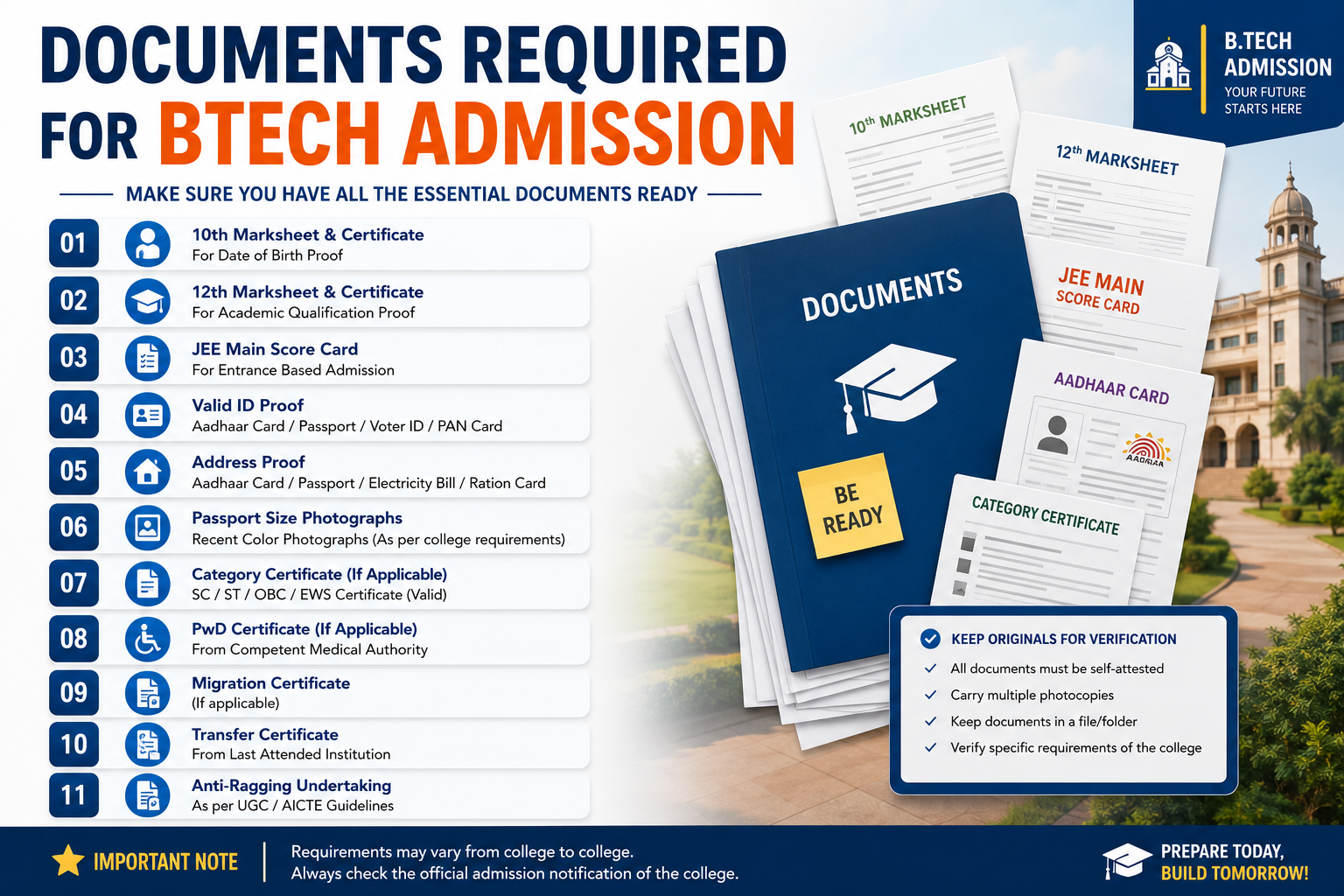
Getting admission into a B.Tech program, whether through JEE Main counseling or direct admission, involves more than just clearing an exam or meeting eligibility criteria. Colleges and universities require a specific set of documents for verification at the time of counseling, seat confirmation, and final admission. Missing even one document can delay or jeopardize your admission process. Here’s a complete, updated checklist of documents required for B.Tech admission in India.
Why Document Verification Matters
Document verification is a mandatory step in both centralized counseling (JoSAA, UPTAC, AKTU, or state-level bodies) and direct/management quota admissions. It confirms your identity, academic eligibility, category status (if applicable), and domicile, ensuring that only genuine and eligible candidates get admitted. Colleges typically verify documents either online during registration or physically at the time of reporting.
Essential Documents for B.Tech Admission
1. Class 10 Marksheet and Certificate
This serves as proof of date of birth and is one of the first documents checked during verification. Ensure your name and date of birth match across all other documents.
2. Class 12 Marksheet and Certificate
Since B.Tech eligibility is based on Class 12 performance in Physics, Chemistry, and Mathematics (PCM), this marksheet is essential to confirm subject-wise marks and overall percentage.
3. JEE Main Admit Card and Scorecard
If you’re being admitted through JEE Main, you’ll need both the admit card (issued before the exam) and the final scorecard/rank card showing your All India Rank (AIR) and category rank.
4. JEE Main Counseling Allotment Letter
This is the seat allotment letter generated after choice filling and seat allocation through JoSAA or UPTAC. It confirms the specific college and branch allotted to you.
5. Category Certificate (if applicable)
Candidates applying under SC, ST, OBC (Non-Creamy Layer), or EWS categories must submit a valid certificate issued by a competent authority, usually not older than one year from the date of admission.
6. Domicile/Residence Certificate
Required for state quota seats, this certificate proves that you are a permanent resident of the state and are eligible for state-level reservation benefits.
7. Transfer Certificate (TC) and Migration Certificate
The Transfer Certificate is issued by your last attended school/institution, while the Migration Certificate is needed if you’re moving from one educational board or university to another (for example, from a state board to a university under a different board).
8. Character Certificate
Issued by the principal of your previous school or college, this certificate confirms your conduct and behavior during your academic tenure.
9. Aadhaar Card
Used as a primary identity proof across almost all admission processes, including online registration, counseling, and verification.
10. Passport-Size Photographs
Most colleges require multiple recent passport-size photographs (usually 6-10 copies) for admission forms, ID cards, and hostel registration.
11. Income Certificate (if applicable)
Required for candidates applying under the EWS category or seeking fee concessions, scholarships, or education loans based on family income.
12. Gap Certificate (if applicable)
If there is a gap year between Class 12 and B.Tech admission, some colleges may require a self-declared or notarized gap certificate explaining the reason for the break.
13. Medical Fitness Certificate
Some universities, especially those with mandatory hostel stays, ask for a basic medical fitness certificate from a registered medical practitioner.
14. Anti-Ragging Affidavit
As per UGC and AICTE norms, both the student and a parent/guardian must submit a signed anti-ragging affidavit, usually generated online through the official anti-ragging portal.
15. Bank Details/Fee Receipt
Proof of seat acceptance fee payment or advance semester fee payment, along with bank account details for any scholarship disbursement.
Additional Documents for Direct Admission (Management Quota)
If you’re opting for direct admission instead of JEE Main counseling, colleges may additionally require:
- A signed admission form from the college’s admission cell
- Original Class 12 marksheet for immediate verification (since there’s no centralized counseling body cross-checking eligibility)
- A demand draft or online payment receipt for the management quota fee
- Sometimes, a personal interview or counseling session record with the admission committee
Tips to Avoid Document-Related Delays
- Keep both originals and photocopies ready — most colleges ask for originals for verification and retain self-attested photocopies.
- Ensure name consistency across Class 10, Class 12, Aadhaar, and JEE Main application — even minor spelling mismatches can cause issues.
- Get category and income certificates updated well in advance, as these often have validity periods and processing time.
- Carry extra passport photographs since colleges frequently need more than initially expected for various forms.
- Check the college’s official document checklist on their website beforehand, as requirements can vary slightly between institutions and states.
Final Thoughts
Whether you’re securing a seat through JEE Main counseling or direct admission, having all your documents organized and verified in advance can save you from last-minute stress and potential seat cancellation. Create a checklist, prepare both original and photocopy sets, and double-check every certificate for accuracy well before your reporting date. A little preparation goes a long way in ensuring a smooth start to your engineering journey.