
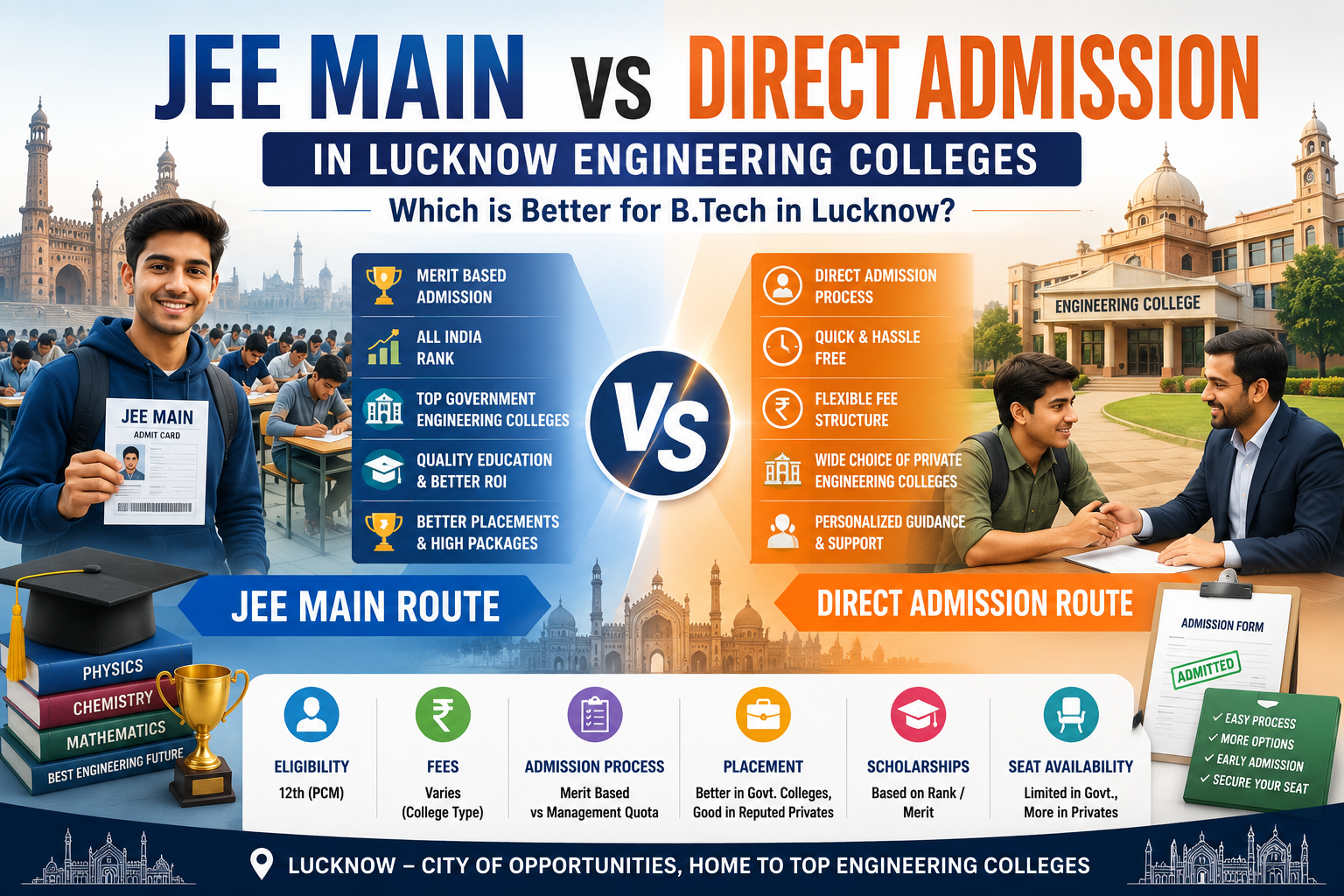
Every year, thousands of students in Uttar Pradesh face the same dilemma while planning their engineering career: should they prepare for JEE Main and go through the formal counseling process, or should they opt for direct admission into a private engineering college in Lucknow? Both routes lead to a B.Tech degree, but the journey, cost, and long-term value can differ significantly. This guide breaks down the two options so you can make an informed decision.
Understanding JEE Main Admission
JEE Main is the Joint Entrance Examination conducted by the National Testing Agency (NTA) for admission into NITs, IIITs, GFTIs, and most state-level engineering colleges, including many in Lucknow such as IET Lucknow (Dr. A.P.J. Abdul Kalam Technical University’s constituent institute), Kamla Nehru Institute of Technology (affiliated colleges), and other AKTU-affiliated institutions that participate in centralized counseling.
To secure admission through JEE Main, a student must:
- Register for and appear in the JEE Main exam (usually held in January and April sessions).
- Score a rank that qualifies for counseling through JoSAA (for NITs/IIITs) or UPTAC/AKTU counseling for state colleges.
- Participate in online counseling, choice filling, and seat allotment rounds.
- Complete document verification and fee payment to confirm the seat.
This process is merit-based, transparent, and regulated by government bodies, which makes it a trusted route for lakhs of students across India.
Understanding Direct Admission
Direct admission refers to securing a seat in a private engineering college without going through the JEE Main counseling process. This is typically done through the management quota or institutional quota available in many private colleges in Lucknow, such as Babu Banarasi Das University, Shri Ramswaroop Memorial University, Amity University Lucknow, Integral University, and several others.
Under this route, admission is usually based on:
- Class 12 marks (with Physics, Chemistry, and Mathematics as core subjects)
- Direct interaction or counseling with the college admission cell
- Payment of the applicable fee structure, which may be higher than the regular quota
Many private universities also accept JEE Main scores for their general quota seats, but they keep a separate management quota for students who did not appear for or qualify in JEE Main.
Key Differences Between the Two Paths
1. Eligibility and Entry Barrier
JEE Main admission requires a competitive exam score, which means students need months of preparation and must clear a certain rank cut-off. Direct admission, on the other hand, generally only requires a minimum percentage in Class 12 (often 45-50%), making it accessible to a wider pool of students, including those who could not clear JEE Main or chose not to attempt it.
2. Cost of Education
This is one of the biggest differentiators. Seats filled through JEE Main counseling (especially in government-aided or AKTU-affiliated colleges) usually come at a regulated, lower fee. Direct admission seats, particularly under management quota, often carry a significantly higher fee, sometimes double or more compared to counseling-based seats, since colleges price these seats at market rates.
3. College and Branch Choice
JEE Main counseling works on a rank-and-preference system. A lower rank may restrict access to top colleges or popular branches like Computer Science. Direct admission offers more flexibility, students can often choose their preferred branch and college directly, as long as seats are available and fees are paid, without competing against a merit list.
4. Time and Process
JEE Main involves exam preparation, multiple counseling rounds, document verification, and seat locking, a process that can take several months. Direct admission is comparatively quick since it bypasses centralized counseling and can often be finalized within days once documents and fees are submitted.
5. Recognition and Perception
Seats secured through JEE Main are generally perceived as more merit-driven, which can matter for scholarships, peer group, and in some cases, campus placement perception. However, most reputed private colleges in Lucknow maintain the same degree, faculty, and placement cell for both JEE-quota and management-quota students, so the classroom experience and degree value remain largely identical once enrolled.
Which Option Should You Choose?
- Choose JEE Main if you want access to government colleges, lower fees, a merit-based process, and are willing to invest time in exam preparation.
- Choose Direct Admission if you missed the JEE Main cut-off, want to skip the counseling hassle, have a specific college or branch preference, and can afford the comparatively higher fee structure.
It’s also worth noting that many students use a hybrid approach: they attempt JEE Main as their primary route, and simultaneously keep a direct admission option as a backup in case their rank doesn’t secure the desired college or branch.
Things to Verify Before Choosing Direct Admission
If you’re leaning towards direct admission, always check:
- The college’s AICTE approval and university affiliation (AKTU or otherwise)
- NAAC/NBA accreditation status
- Placement records for the last 3-5 years
- Total fee structure, including hostel, exam, and miscellaneous charges
- Whether the management quota seat is officially sanctioned and not sold outside approved limits
Final Thoughts
Both JEE Main and direct admission are valid, legitimate pathways into engineering colleges in Lucknow. The right choice depends on your budget, timeline, academic performance, and career priorities. Students aiming for top-tier government institutes should prioritize JEE Main preparation, while those seeking flexibility, a quicker process, or a specific private college should explore direct admission options, after verifying the college’s credentials thoroughly. Ultimately, your effort and consistency during the four years of engineering matter more for your career than which route got you the seat.